Why Can't the Transit Agency Just Add Another Bus?
Why one additional trip can require far more resources than passengers may realize
By Craig10 min read
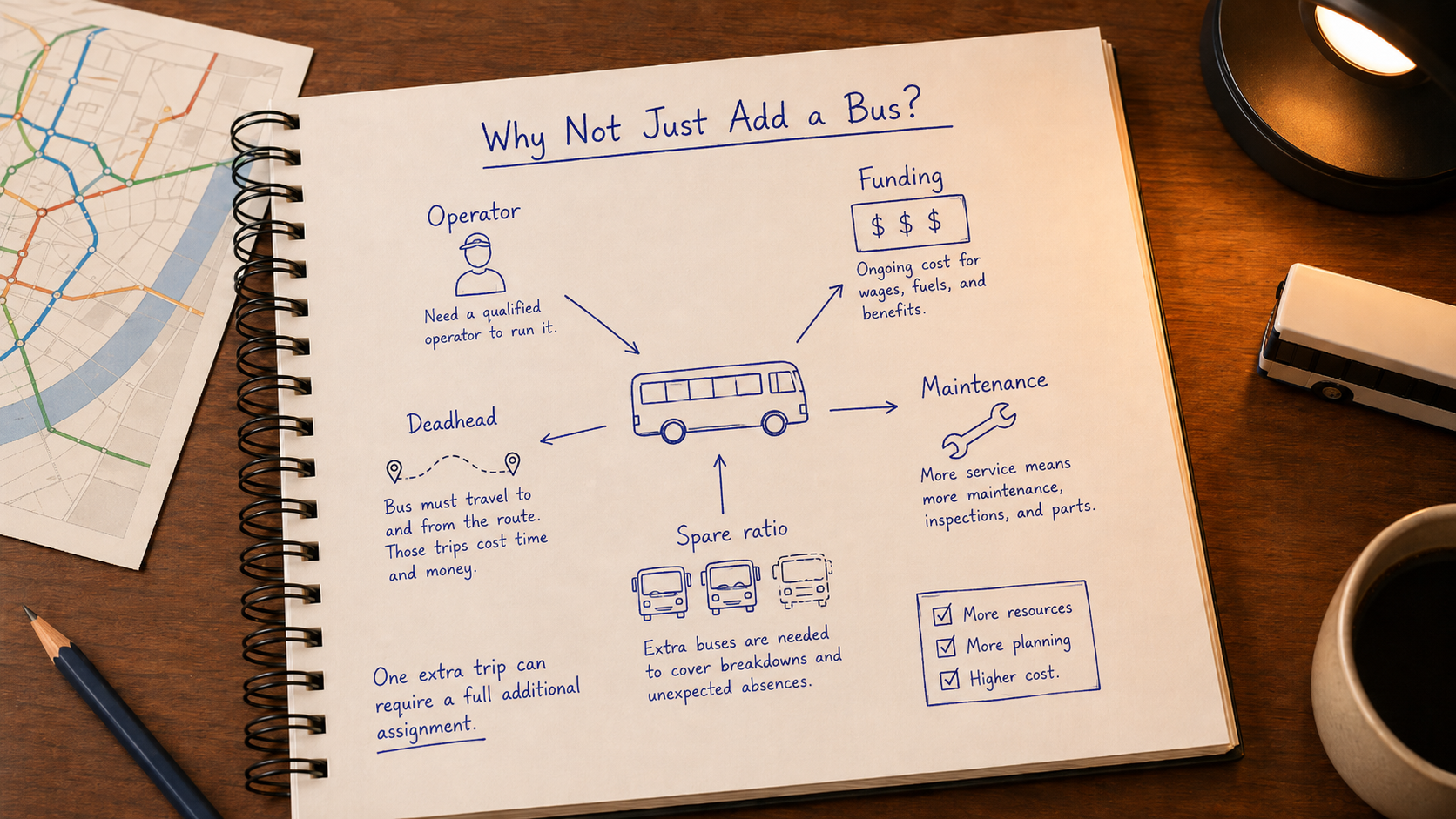
When a bus is crowded, a route has a long gap, or passengers request more frequent service, a common response is:
Why can't the transit agency just add another bus?
From the passenger's perspective, the solution appears obvious. Put another bus on the route and operate an extra trip.
In reality, the bus itself is only one part of the cost and operating requirement.
A Bus Needs an Operator
The most immediate requirement is a qualified operator.
Adding a bus to service means someone must drive it. Depending on the length and timing of the assignment, one additional bus may require more than one operator over the course of the day.
The agency must account for:
- Available operators
- Work rules
- Report and travel time
- Breaks and meal periods
- Overtime
- Absences
- Training
- Spare coverage
If the agency is already experiencing an operator shortage, adding scheduled service may increase the number of missed trips instead of improving reliability.
A timetable is only meaningful when the agency has enough people to operate it.
The Bus Must Be Available
Transit agencies do not place every vehicle in the fleet into service each day.
Some buses must remain available as spares. Others may be undergoing inspections, repairs, cleaning, fueling, charging, or scheduled maintenance.
The fleet needs enough spare capacity to cover:
- Breakdowns
- Collisions
- Preventive maintenance
- Unplanned repairs
- Vehicle exchanges
- Specialized service requirements
Using every bus during normal service leaves no practical protection when something goes wrong.
The question is therefore not simply whether the agency owns another bus. The question is whether another service-ready bus can be committed every day without weakening the rest of the system.
One Trip May Require an Entire Additional Bus
An extra trip does not always fit neatly between existing trips.
Suppose a route has buses departing every hour, and each round trip-including recovery-takes two hours. Two buses can operate the service in a repeating pattern.
Now suppose the agency wants to add one trip during the afternoon.
If no existing bus is available at that time and location, the new trip may require another bus to leave the yard, travel out of service to the starting point, operate the trip, and then return to the yard.
The public sees one extra trip. The agency may be paying for:
- Pull-out time
- Deadhead mileage
- Operator report time
- The passenger trip
- Recovery time
- Pull-in time
A 60-minute passenger trip can create several hours of total operating expense.
Deadhead Is Necessary but Not Visible
Deadhead is the movement of a bus without passengers, usually between the yard and a route or between two assignments.
Passengers generally do not see deadhead time in the timetable, but it is essential to building the service.
A bus may have to travel a considerable distance before it reaches the start of a route. This is especially important in large or rural service areas where communities are separated by many miles.
An extra trip far from the operating facility can cost much more than a similar trip near the yard.
Geography matters.
Operating Cost Continues Every Day
The cost of service is not limited to purchasing a bus.
Regular operating expenses include:
- Operator wages and benefits
- Fuel or electricity
- Maintenance
- Tires and parts
- Cleaning
- Insurance
- Supervision
- Dispatching
- Technology systems
- Administrative support
Once a new trip is placed in the public timetable, passengers depend on it. The agency must be prepared to fund and operate that trip consistently, not merely when conditions are convenient.
Starting service without stable funding can lead to future reductions and damage public confidence.
Vehicle Type Can Matter
Some assignments require a particular type of bus.
A heavily used trip may need a larger vehicle. A long-distance block may require greater fuel or battery range. A route with certain road conditions may not be suitable for every vehicle in the fleet.
Battery-electric buses create additional planning considerations.
The planner must evaluate:
- Total block mileage
- Energy consumption
- Weather
- Heating and cooling demands
- Elevation changes
- Charging time
- Charger availability
- Operational reserve
The fact that an electric bus can operate one trip does not automatically mean it can operate the entire block assigned to that vehicle.
Service planning must account for the complete day.
Transit-Center and Road Capacity
Another bus also needs space.
At a transit center, the added trip may require:
- An available bay
- A safe staging location
- Passenger loading space
- Enough circulation time
- Coordination with connecting buses
On the route, the new trip may interact with other buses, school traffic, freight activity, or limited terminal space.
A schedule cannot be built without considering where the bus will wait, load, turn around, and recover.
Ridership Demand Still Matters
Transit agencies have a responsibility to use public resources carefully.
Adding service may be justified when buses are overcrowded, passengers are being left behind, major destinations have changed, or existing frequency no longer meets demonstrated demand.
However, not every request can be implemented.
A requested trip may serve only a small number of passengers while requiring substantial daily expense. The agency may have other routes where the same resources would benefit many more people.
That does not mean the smaller need is unimportant. It means transit planning often involves choosing between several legitimate needs with limited funding.
Sometimes the Better Answer Is Not Another Bus
Before adding a bus, planners may examine other options:
- Adjusting departure times
- Changing running time
- Reassigning an existing trip
- Using a larger vehicle
- Improving connections
- Shortening a portion of the route
- Adding service only during the busiest period
- Modifying blocks
- Reducing duplication
- Coordinating with another route
A relatively small schedule change can sometimes solve the problem without requiring a full additional vehicle.
At other times, another bus truly is the right answer. The important point is that the decision must be supported by resources and a workable operating plan.
The Planner's Takeaway
Adding another bus is never just about the bus.
It requires an operator, funding, maintenance capacity, terminal space, a workable block, and enough fleet availability to operate reliably every day.
A good planner should never dismiss a request simply because it is difficult. But the honest answer must consider the entire system-not just the one trip passengers can see.
Article 5: Why Buses Bunch-and Why the Second Bus Cannot Always Just Pass
Few transit experiences are more frustrating than waiting a long time for a bus and then seeing two buses arrive together.
Passengers naturally wonder why the buses are traveling as a pair instead of maintaining their scheduled spacing.
This problem is known as bus bunching.
It is common on frequent routes, and once it begins, it can become worse without some form of intervention.
How Bunching Starts
Imagine a route where buses are scheduled every 15 minutes.
The first bus encounters a delay. It may be caused by traffic, a long red light, a mobility-device boarding, a blocked stop, or an unusually large number of passengers.
The bus is now five minutes late.
Because it is late, more passengers have accumulated at the next stops. More passengers take longer to board, which makes the bus even later.
Meanwhile, the following bus is experiencing the opposite condition. Because the first bus is carrying many of the waiting passengers, fewer people remain for the second bus.
The second bus spends less time at stops and begins to catch up.
The late bus gets slower. The following bus gets faster.
Eventually, the two buses arrive together.
The Snowball Effect
Bus bunching is self-reinforcing.
The lead bus may become increasingly crowded because it reaches each stop first. A crowded bus takes longer to load and unload.
The following bus may remain lightly loaded and continue gaining ground.
Once the spacing becomes uneven, the normal schedule alone may not correct it. Dispatch or field supervision may need to intervene.
This is why bunching can continue even after the original traffic delay has ended.
Why Does the Second Bus Not Just Pass?
Passing can sometimes help, but it is not always simple or appropriate.
There may be legal, safety, customer-service, and operational reasons not to pass.
The Lead Bus May Still Have Passengers Waiting
If the second bus passes the first, passengers at the next stop may be expecting the lead bus to serve them.
The passing bus may have a different destination, route variation, or stopping pattern. Even when both buses are on the same route, the operator must know whether passing will help restore spacing or merely create more confusion.
The Street May Not Allow Safe Passing
The buses may be operating on a two-lane road, in heavy traffic, near an intersection, or alongside parked vehicles.
A transit bus cannot always maneuver around another bus safely.
Even on a multilane road, the passing bus may immediately become trapped at a signal or need to return to the curb at the next stop.
The Buses May Not Be Operating the Same Trip Pattern
Two buses displaying the same route number may not have identical assignments.
One may:
- Terminate earlier
- Continue farther
- Serve a deviation
- Operate an express segment
- Be scheduled to connect with another route
- Be returning to the yard after a particular trip
Allowing one bus to pass without considering the complete assignment can create a new problem later.
Passing Does Not Restore Proper Spacing by Itself
If the second bus passes, the two vehicles may simply exchange positions while remaining close together.
The original lead bus is still crowded and delayed. The passing bus may now begin collecting passengers ahead of it.
Without additional action, the pair may continue operating only a few minutes apart.
The goal is not merely to change which bus is first. The goal is to restore useful spacing between them.
How Transit Agencies Respond
There are several ways to address bunching, depending on the route and circumstances.
Holding
The following bus may be held at a timepoint or transit center to recreate space behind the lead bus.
Passengers on the held bus may understandably be frustrated, especially if they feel their bus is being delayed unnecessarily.
However, the hold may improve service for passengers along the rest of the route.
Holding works best when used carefully. Excessive holding can create another gap behind the delayed bus.
Stop Skipping
Dispatch may direct one bus to skip selected stops, usually when another bus is available to serve those passengers.
This can help the delayed vehicle regain time, but it must be used cautiously. Passengers need clear information, and accessibility obligations must be respected.
Short Turning
A bus may be turned around before reaching the normal end of the route so it can return in the opposite direction and fill a large service gap.
Short turns can improve overall route spacing but inconvenience passengers who need to travel beyond the turnback point.
This strategy requires careful communication and a safe place for the bus to reverse direction.
Expressing One Bus
One of the bunched buses may be directed to operate with limited stops for part of the route.
This can redistribute passengers and separate the buses, but it depends on road conditions, route design, and the availability of another bus to serve skipped stops.
Adjusting the Schedule
If bunching occurs regularly at the same time and location, the underlying timetable may need to be changed.
Possible adjustments include:
- Adding running time
- Changing recovery
- Revising departure times
- Modifying timepoints
- Adding service
- Changing stop spacing
- Adjusting traffic-signal priority
- Revising route structure
Dispatch can manage an unusual event. It should not have to compensate every day for an unrealistic schedule.
Why Frequent Routes Are Vulnerable
Bunching is most noticeable on routes with frequent service.
On an hourly route, each bus is usually operating as a separate event. On a route running every ten or fifteen minutes, buses continuously interact with passenger demand and traffic conditions.
Even a small delay can represent a large percentage of the scheduled spacing.
A five-minute delay on a 60-minute service is inconvenient. A five-minute delay on a 10-minute service eliminates half the intended separation between buses.
This is one reason high-frequency service requires active management.
Passenger Information Matters
Passengers often judge bunching by what they can see at one moment.
They may not know that:
- One bus was delayed by an incident
- The buses have different terminal points
- Dispatch is attempting to restore spacing
- One vehicle is operating a replacement trip
- A road closure has changed the service pattern
Real-time information can help explain what is happening, but it does not solve the underlying operating problem.
The best outcome is still reliable, evenly spaced service.
Prevention Is Better Than Correction
Bunching cannot be eliminated entirely. Streets are unpredictable, and passenger demand varies.
It can be reduced through:
- Realistic running times
- Adequate recovery
- Active supervision
- Reliable vehicles
- Appropriate frequency
- Well-designed stops
- Transit-priority measures
- Clear operator instructions
- Timely service data
Good schedule design creates a stronger foundation. Good operations management helps protect that schedule when unexpected conditions occur.
This article reflects the author's personal experience and general industry knowledge. Agency practices, labor agreements, laws, funding requirements, and operating conditions vary.
Related Articles
Transit Operations6 min read
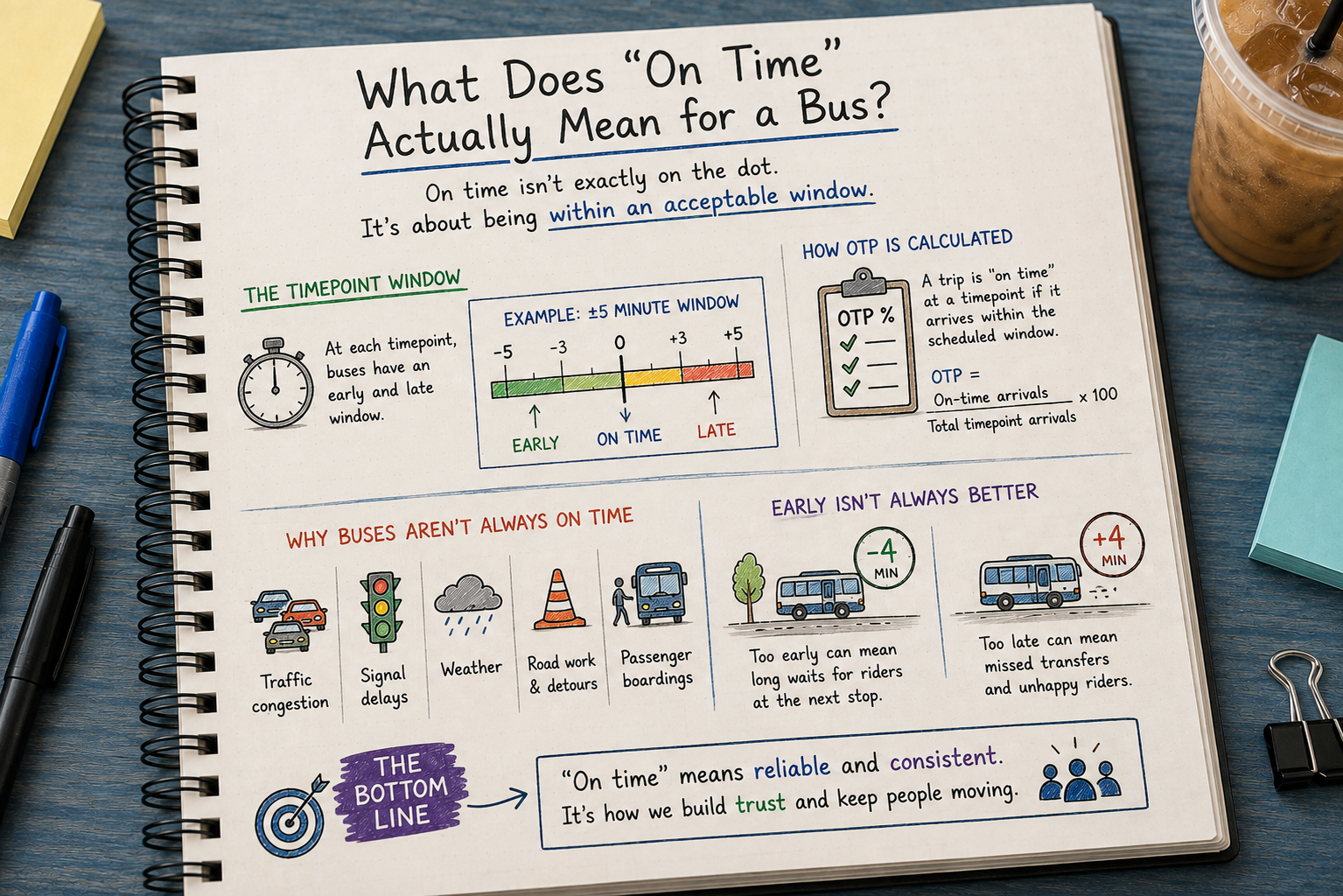
What Does “On Time” Actually Mean for a Bus?
On-time performance is one of transit’s most important service measures, but “on time” does not always mean arriving at the exact scheduled minute. Understanding early departures, late arrivals, timepoints, and schedule adherence helps explain what the numbers really measure.
Read Article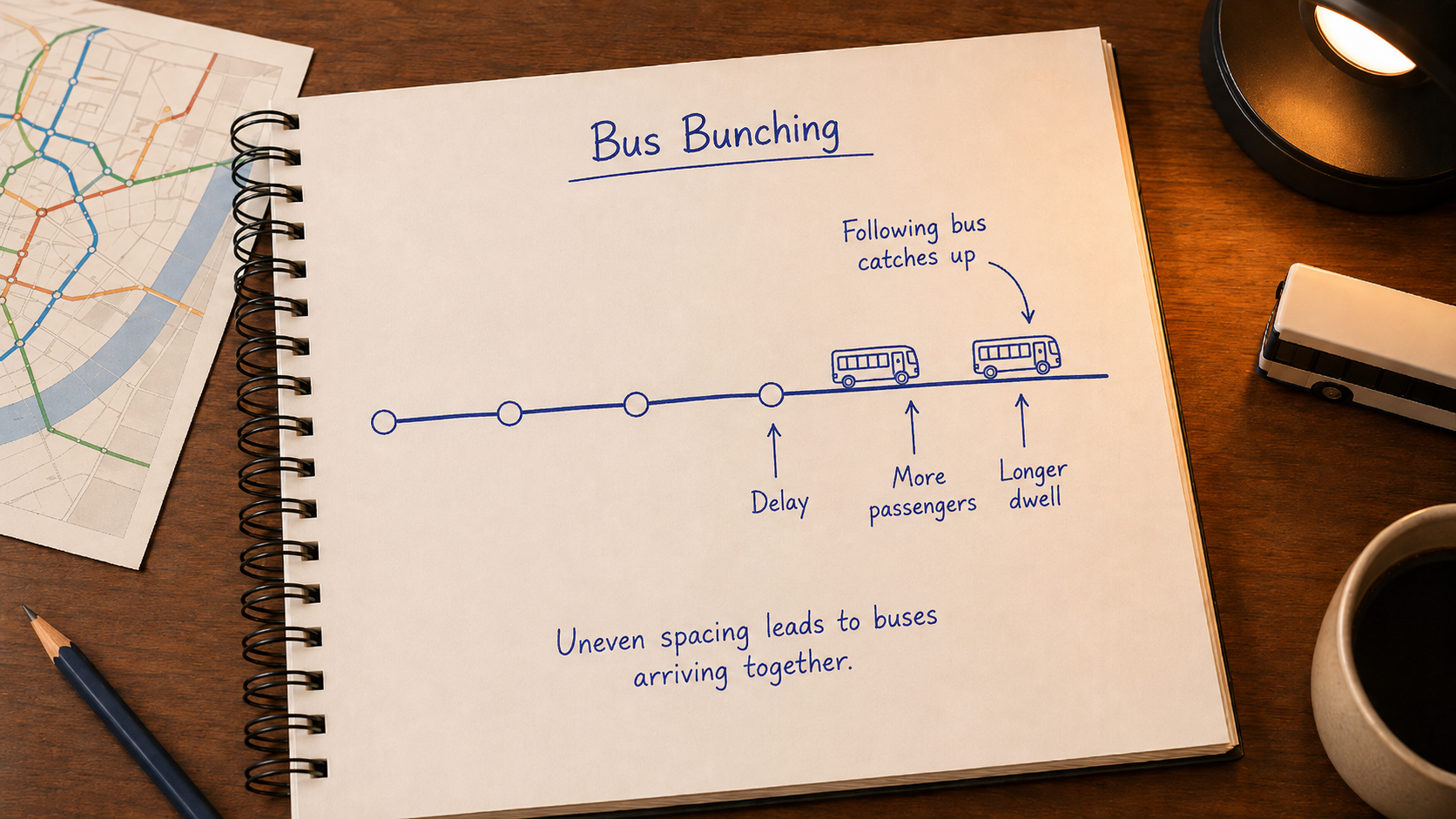
Transit Operations5 min read
Why Buses Bunch—and Why the Second Bus Cannot Always Just Pass
Bus bunching often begins with a small delay that causes one bus to carry more passengers while the following bus catches up. This article explains how bunching develops, why simply passing is not always the answer, and how transit agencies try to restore proper spacing.
Read Article