What Does “On Time” Actually Mean for a Bus?
How transit agencies measure schedule adherence — and why early can be worse than late
By Craig6 min read
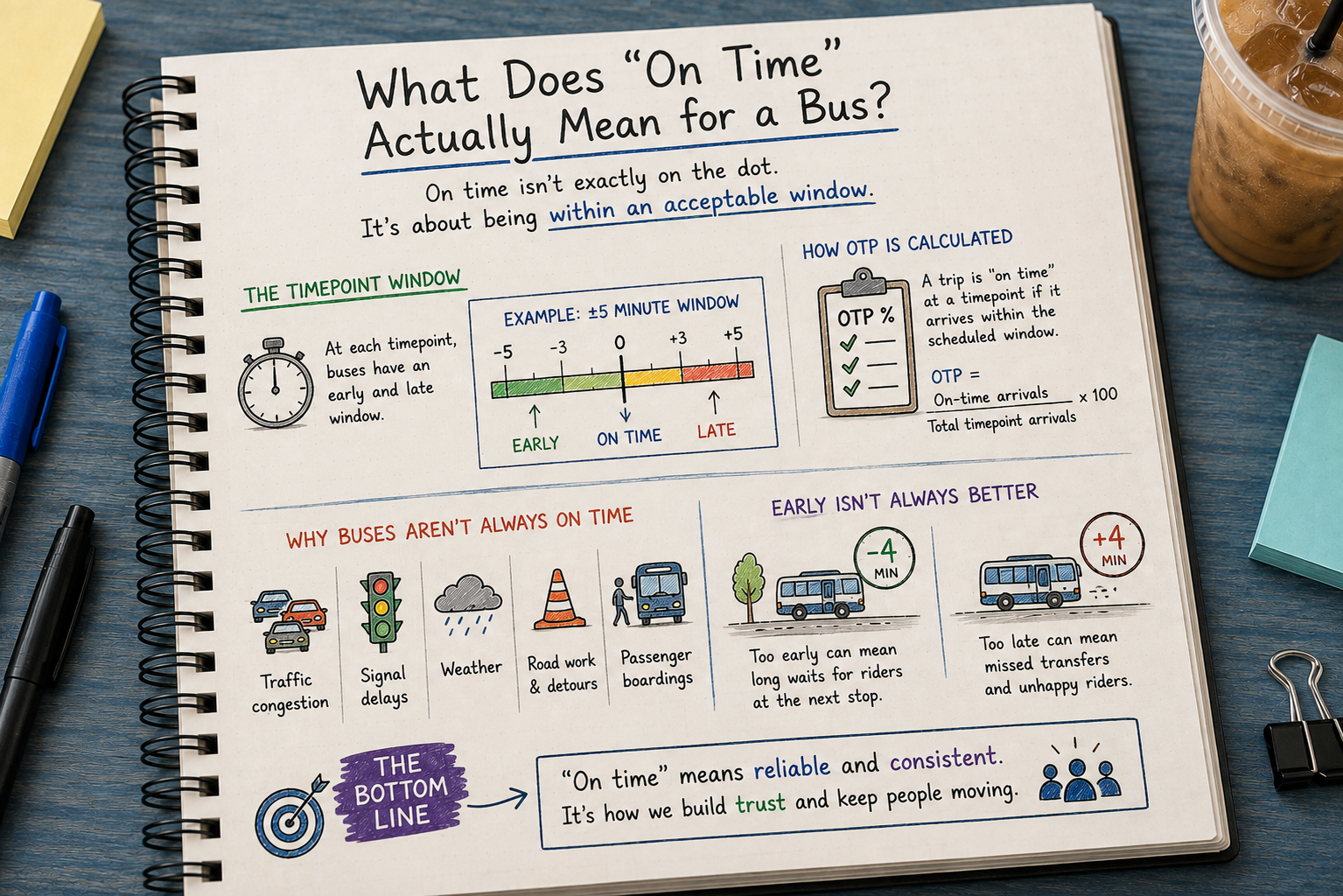
A bus is scheduled for 8:00.
It arrives at 8:02.
Is it late?
What if it arrives at 7:58?
What if it arrives early but waits until 8:00 to leave?
Transit agencies spend considerable effort measuring on-time performance, commonly abbreviated OTP.
But the definition of “on time” is more complicated than matching a clock to the exact minute.
Transit Operates in the Real World
A perfectly scheduled bus would reach every location at exactly the published time.
Real streets do not work that way.
Traffic lights vary. Passengers board at different speeds. Collisions occur. Weather changes. Freight trains cross the roadway. Construction closes lanes.
Expecting every bus to reach every timepoint at precisely the scheduled second would be unrealistic.
Transit agencies therefore generally define an acceptable window around the scheduled time.
The exact standard varies by agency.
Early and Late Are Not Equal
Passengers frequently assume that a bus arriving early is better than one arriving late.
From a service standpoint, that is often not true.
Consider a bus scheduled to depart at 8:00.
A passenger arrives at 7:58.
If the bus departed at 7:56, the passenger has missed it even though the bus was technically “ahead of schedule.”
The passenger did everything correctly.
The bus did not.
This is why early departures from published timepoints can be particularly harmful.
A Bus Can Arrive Early Without Departing Early
There is an important distinction between arrival and departure.
Suppose a bus reaches a transit center at 7:55 for an 8:00 departure.
That is not necessarily a problem.
The bus can wait until 8:00.
In fact, that waiting time may be intentionally scheduled recovery or layover.
What matters to the waiting passenger is that the bus does not leave before the advertised departure time.
Timepoints Versus Every Stop
Public timetables usually show scheduled times at selected locations called timepoints.
The bus may serve many additional stops between them.
For example:
- Transit Center — 8:00
- Main & 5th — 8:15
- College — 8:30
- Mall — 8:45
There may be 20 other stops along that route.
Those intermediate stops may have estimated times in trip-planning systems, but the traditional operating schedule is generally controlled around designated timepoints.
This allows the operator some flexibility to respond to normal variation between scheduled locations.
Why Early Running Happens
A bus can get ahead of schedule for several reasons.
Traffic may be lighter than expected.
Passenger activity may be unusually low.
A school may be closed.
A normally busy intersection may have little traffic.
The operator may then need to regulate the service at an appropriate timepoint.
Without that regulation, the bus may continue getting farther ahead.
Why Late Running Happens
Lateness has many causes:
- Traffic congestion
- Heavy boarding
- Road construction
- Collisions
- Detours
- Mechanical problems
- Weather
- Railroad crossings
- Unusual passenger needs
The important planning question is whether the delay is occasional or recurring.
A single late trip may simply reflect unusual conditions.
If the same trip is late almost every weekday, the schedule may need attention.
When the Schedule Is the Problem
Sometimes poor on-time performance is not primarily an operations problem.
The schedule itself may no longer reflect actual conditions.
In one real-world weekday service example, schedules had historically been built around 60- and 30-minute patterns. Over time, traffic congestion and development increased, and buses could no longer reliably complete their trips and still receive adequate recovery within those cycles.
On-time performance had fallen into the mid-60 percent range.
At that point, continuing to demand the same schedule would not have made the buses move faster.
The timetable was asking the service to do something the operating data showed it could no longer consistently do.
After careful review and data analysis, the schedules were revised to 70- and 35-minute patterns.
Within approximately one month, on-time performance increased to about 85 percent.
Since then, monthly performance has generally remained in the 85–87 percent range.
Ridership also increased slightly after the service became more reliable. While many factors can affect ridership, dependable service is an important part of making transit useful.
The basic reasoning behind the change was simple:
If a bus is scheduled to be there at 7:30 but consistently arrives around 7:35, continuing to publish 7:30 does not make the bus faster. It simply makes the schedule wrong.
Changing the timetable to 7:35 may not appear to give the passenger anything new.
The bus was already arriving around 7:35.
What changes is the promise being made to the passenger.
Instead of telling someone to expect a bus at a time that repeatedly cannot be met, the timetable now reflects when the service can realistically be delivered.
That allows passengers to plan with greater confidence.
This Is Not Manipulating the Numbers
There is an important distinction between correcting an unrealistic schedule and simply changing standards to improve a performance statistic.
The purpose of schedule adjustment should not be to manufacture a better OTP percentage.
The purpose should be to align the published timetable with actual operating conditions.
That decision should be supported by evidence such as:
- Actual running times
- Repeated late patterns
- Traffic conditions
- Passenger activity
- Recovery performance
- Time-of-day differences
- Field observations
If the data shows that buses consistently require more time, the responsible planning decision may be to provide that time.
The resulting improvement in OTP is then evidence that the new timetable better matches reality.
Reliability Can Be More Valuable Than an Aggressive Schedule
A schedule can look impressive on paper.
It may advertise shorter travel times or cleaner 30-minute departures.
But if buses routinely fail to meet those times, passengers are not receiving the service shown in the timetable.
A slightly slower schedule that is dependable may provide a better passenger experience.
Suppose one timetable promises a bus at 7:30 but the bus routinely arrives at 7:35.
Another timetable tells passengers from the beginning that the bus is scheduled for 7:35 and consistently delivers it.
The second schedule may technically be five minutes slower.
It is also more useful.
Passengers can plan around something they can trust.
OTP Is a Planning Tool
On-time performance is often discussed as a score.
For planners, it is more useful as a diagnostic tool.
Suppose one route has poor performance between 3:00 and 5:00 PM.
The planner can examine:
- Which trips are late
- Where they begin losing time
- Whether traffic is responsible
- Whether passenger loads have increased
- Whether recovery is sufficient
- Whether the running time should change
The objective is not merely to improve a percentage.
It is to understand what the percentage is telling us.
A High OTP Number Is Not Automatically a Good Schedule
Imagine a schedule with so much running time that buses regularly arrive early and wait at timepoints.
The OTP statistics may look excellent.
Passengers, however, may be experiencing unnecessarily slow trips.
Conversely, a schedule that is extremely tight may produce poor OTP even though operators are working efficiently.
Performance measures should therefore be interpreted in context.
A good schedule balances reliability and reasonable travel time.
Data Quality Matters
Modern transit agencies increasingly depend on automated data.
That creates tremendous opportunities, but the underlying data must still be reviewed.
Problems can occur if:
- GPS locations are incorrect
- Timepoints are configured improperly
- Trips are matched incorrectly
- Vehicle assignments are missing
- Detours alter the normal route
- Equipment stops reporting
Bad data can produce very precise-looking numbers that are still wrong.
Automated measurement does not eliminate the need for professional judgment.
Operator Feedback Still Matters
Data may show where a bus loses eight minutes.
An operator may explain why.
Perhaps a particular left turn routinely requires several traffic-signal cycles.
Perhaps school traffic blocks the roadway at a predictable time.
Perhaps passenger activity has increased at a particular stop.
The strongest schedule analysis combines operating data with field knowledge.
Neither should exist in isolation.
OTP Should Lead to Action
When recurring performance problems are identified, planners may consider:
- Adjusting running time
- Changing timepoints
- Revising recovery
- Moving departure times
- Modifying connections
- Adjusting the route
- Coordinating with traffic engineering
- Monitoring the problem further
Not every performance issue requires a schedule change.
But recurring problems should not simply be accepted because “traffic happens.”
The purpose of performance measurement is improvement.
Tags
This article reflects the author's personal experience and general industry knowledge. Agency practices, labor agreements, laws, funding requirements, and operating conditions vary.
Related Articles
Transit Operations5 min read
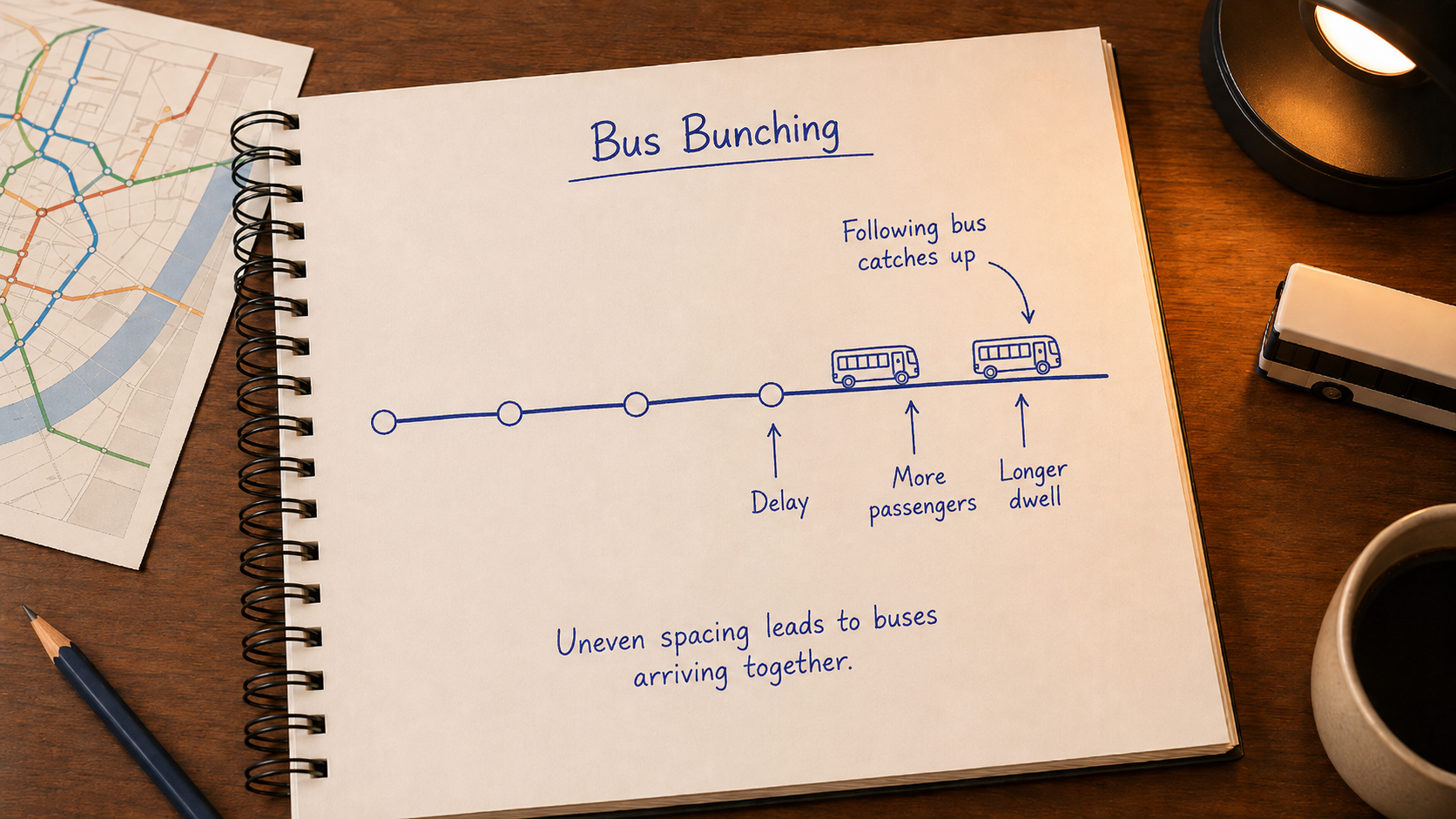
Why Buses Bunch—and Why the Second Bus Cannot Always Just Pass
Bus bunching often begins with a small delay that causes one bus to carry more passengers while the following bus catches up. This article explains how bunching develops, why simply passing is not always the answer, and how transit agencies try to restore proper spacing.
Read Article
Transit Operations10 min read
Why Can't the Transit Agency Just Add Another Bus?
Adding service involves more than finding an available bus. Operators, funding, maintenance, deadhead time, spare vehicles, terminal space, and the structure of the existing schedule all determine whether an additional trip can actually be operated.
Read Article