What Is a Timepoint - and Why Doesn't Every Bus Stop Have a Scheduled Time?
How selected stops anchor the timetable without trying to schedule every stop along the route
By Craig3 min read
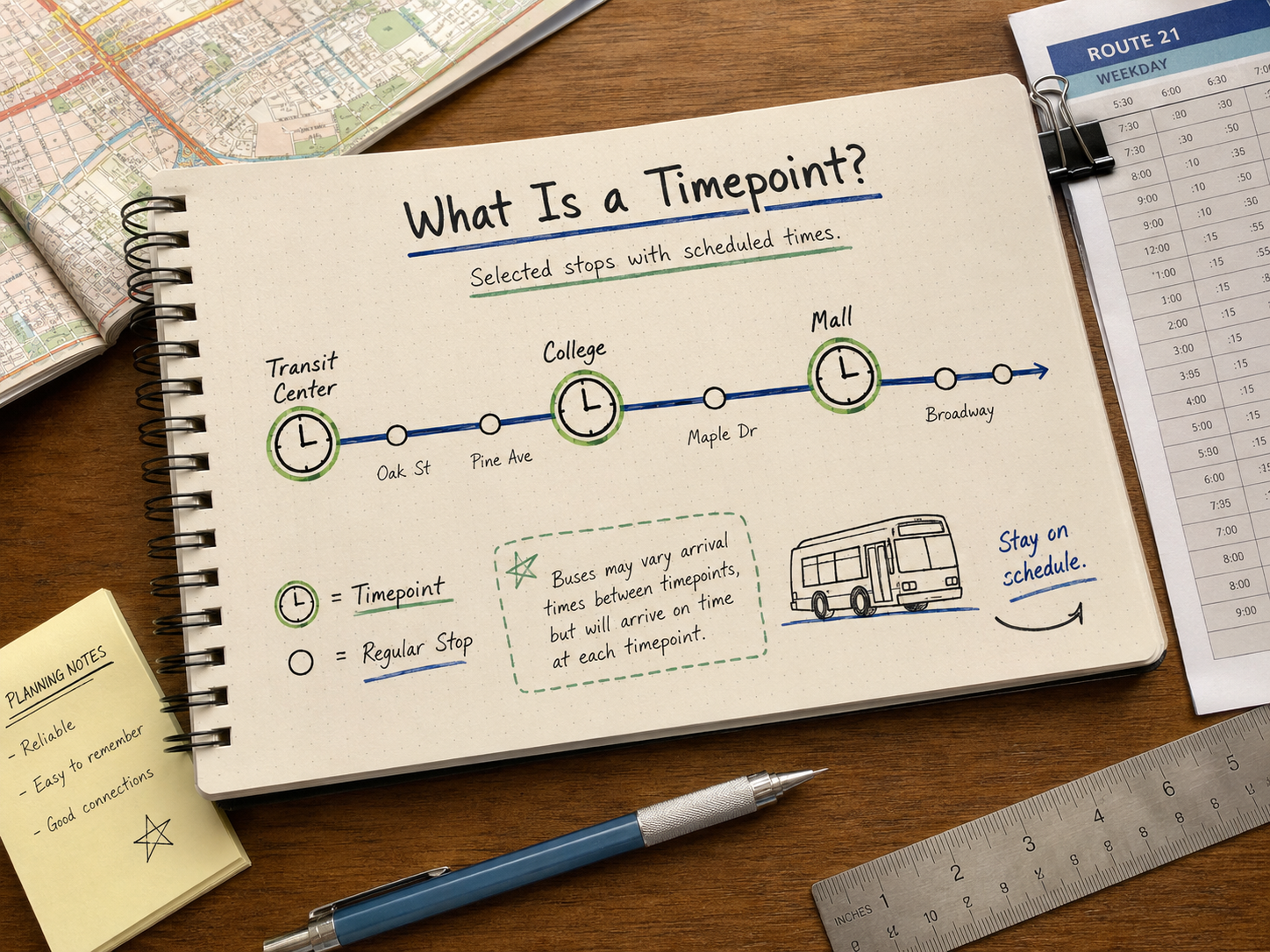
Look at a traditional bus timetable and you may notice something interesting.
A route might serve 40 or 50 bus stops, yet the timetable lists only six or eight locations.
What happened to all the stops in between?
They are still there. They simply are not all designated as timepoints.
What Is a Timepoint?
A timepoint is a selected location along a route where the schedule establishes a specific time for the bus.
- Transit centers
- Route terminals
- Major intersections
- Shopping centers
- Colleges or universities
- Major transfer locations
- Important community destinations
These locations create the framework of the timetable.
A route might look something like:
- Transit Center - 8:00
- Main & Central - 8:15
- College - 8:28
- Mall - 8:42
- Route Terminal - 8:55
The bus may serve many additional stops between those locations.
Why Not Schedule Every Stop?
At first, publishing a scheduled time for every stop may sound more useful.
In practice, it can create problems.
Transit service contains natural variation. One trip may have three passengers boarding between two timepoints while another has fifteen. Traffic signals change. Wheelchair boardings occur. Traffic volumes fluctuate.
If every stop were treated as a rigid scheduled location, operators could spend substantial amounts of time waiting simply because the bus reached an intermediate stop earlier than predicted.
That can make service unnecessarily slow.
Timepoints provide enough structure to regulate the service without attempting to predict every second of the trip.
What About Trip-Planner Times?
Modern trip-planning applications frequently display estimated times for every stop.
Those times usually come from schedule data and the running time assigned between points.
That does not necessarily mean every displayed stop is an operating timepoint.
This distinction is important.
A passenger may see an estimated 8:17 arrival at an intermediate stop, while the actual operating schedule may be controlled by an 8:15 timepoint before it and an 8:25 timepoint after it.
The intermediate time is useful for trip planning, but it is still part of a larger scheduled segment.
Operators Should Not Run Early
Timepoints also help operators regulate early running.
Suppose a bus reaches a scheduled 10:20 timepoint at 10:17.
Depending on agency procedures, the operator may need to wait until the scheduled departure time.
This protects passengers who reasonably expect the bus to be there at 10:20.
The same principle is much harder to apply at every single stop without making the service cumbersome.
Choosing Good Timepoints
A good timepoint should generally be:
- Easy for passengers to identify
- Operationally practical
- Located at an important point along the route
- Reasonably spaced from other timepoints
- Safe for the bus to wait when necessary
A poor timepoint might be located where the bus cannot safely hold, where passengers cannot easily identify the location, or only a minute or two from another scheduled point.
Too Many Timepoints
Adding more timepoints does not automatically improve a schedule.
Too many can create:
- Excessive operator holding
- Slower service
- Complicated timetables
- More opportunities for apparent schedule violations
- Less flexibility between major locations
The goal is to provide enough scheduled reference points to control the route without micromanaging every movement.
Too Few Timepoints
Too few can create the opposite problem.
Passengers may have difficulty knowing when to expect the bus, and operators may have insufficient opportunities to regulate early service.
On a long route, a large gap between scheduled points can make the timetable less useful.
Again, balance matters.
Timepoints Can Change
Timepoints are not necessarily permanent.
A service change may:
- Add a new major destination
- Remove an outdated timepoint
- Relocate one to a better stop
- Change timing because of route restructuring
- Add a transit center or transfer point
When that happens, the public timetable and underlying transit data must be updated together.
Tags
This article reflects the author's personal experience and general industry knowledge. Agency practices, labor agreements, laws, funding requirements, and operating conditions vary.
Related Articles
Scheduling Explained4 min read
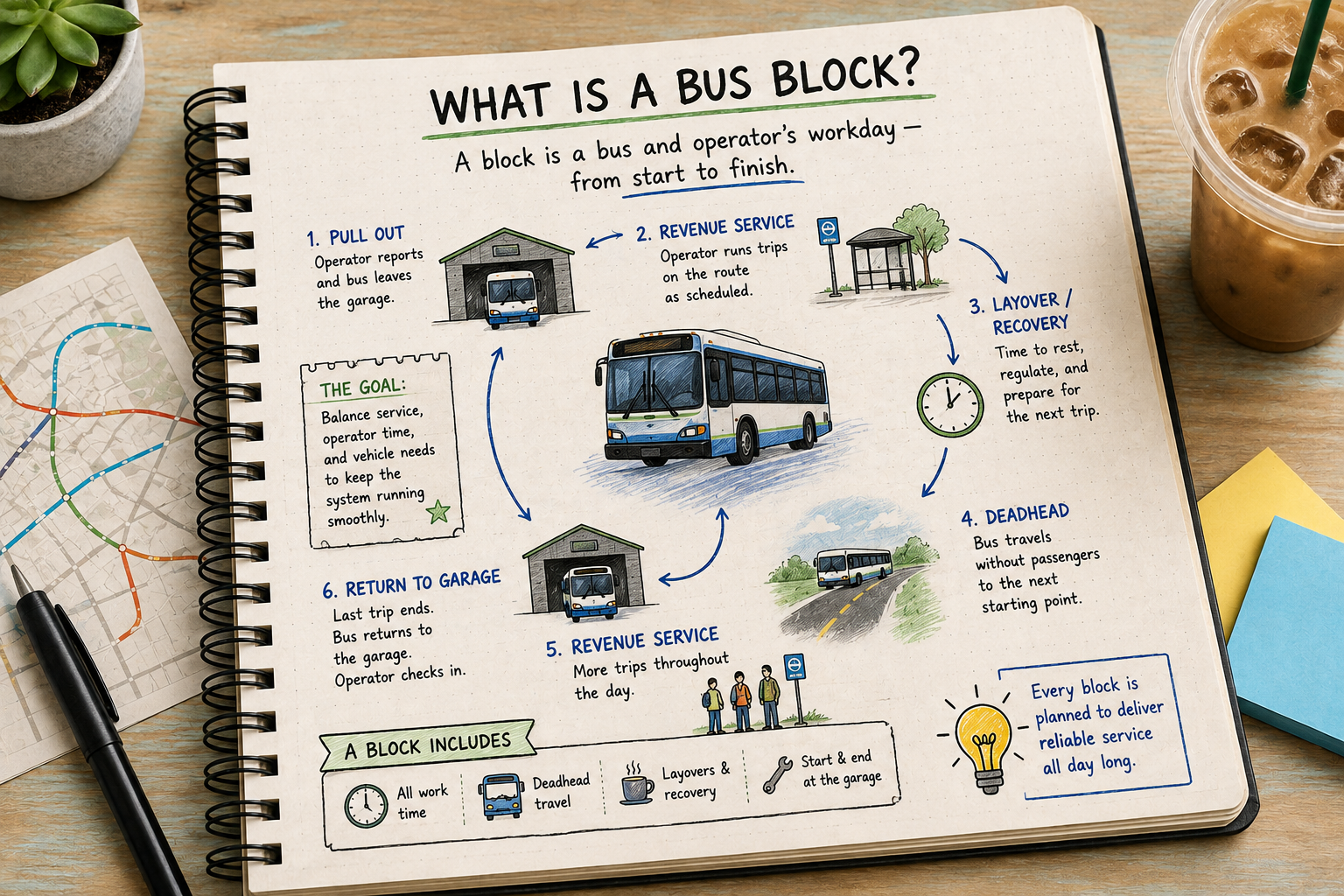
What Is a Bus Block?
Passengers see routes and trips, but planners must also determine what each bus does throughout the day. A block connects individual trips, deadhead movements, layovers, and vehicle requirements into one continuous operating assignment.
Read Article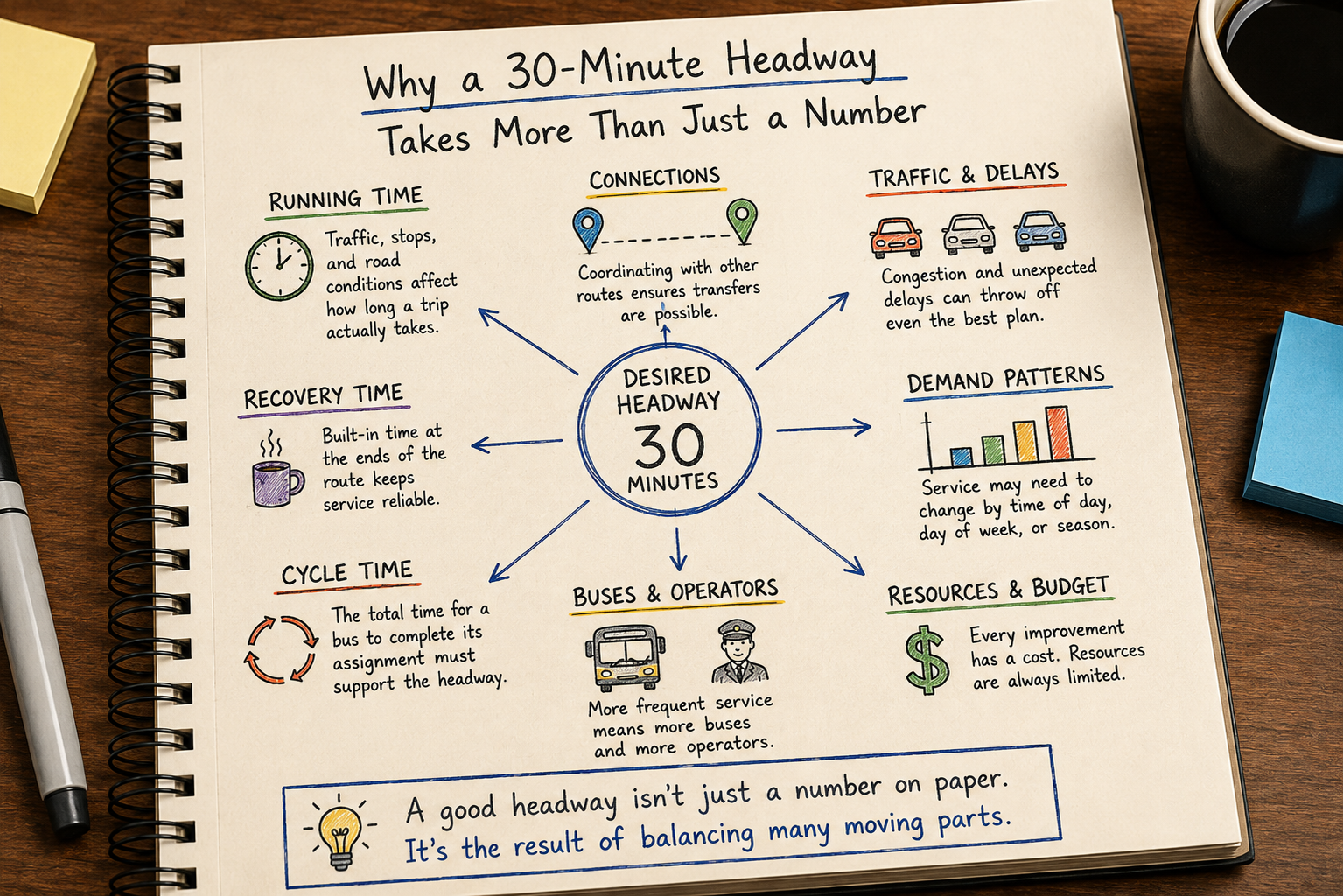
Scheduling Explained5 min read
Headways: Why “Every 30 Minutes” Is More Complicated Than It Sounds
A route that operates every 30 minutes may sound simple, but maintaining that frequency depends on running time, recovery, available buses, connections, and the overall cycle time of the route.
Read Article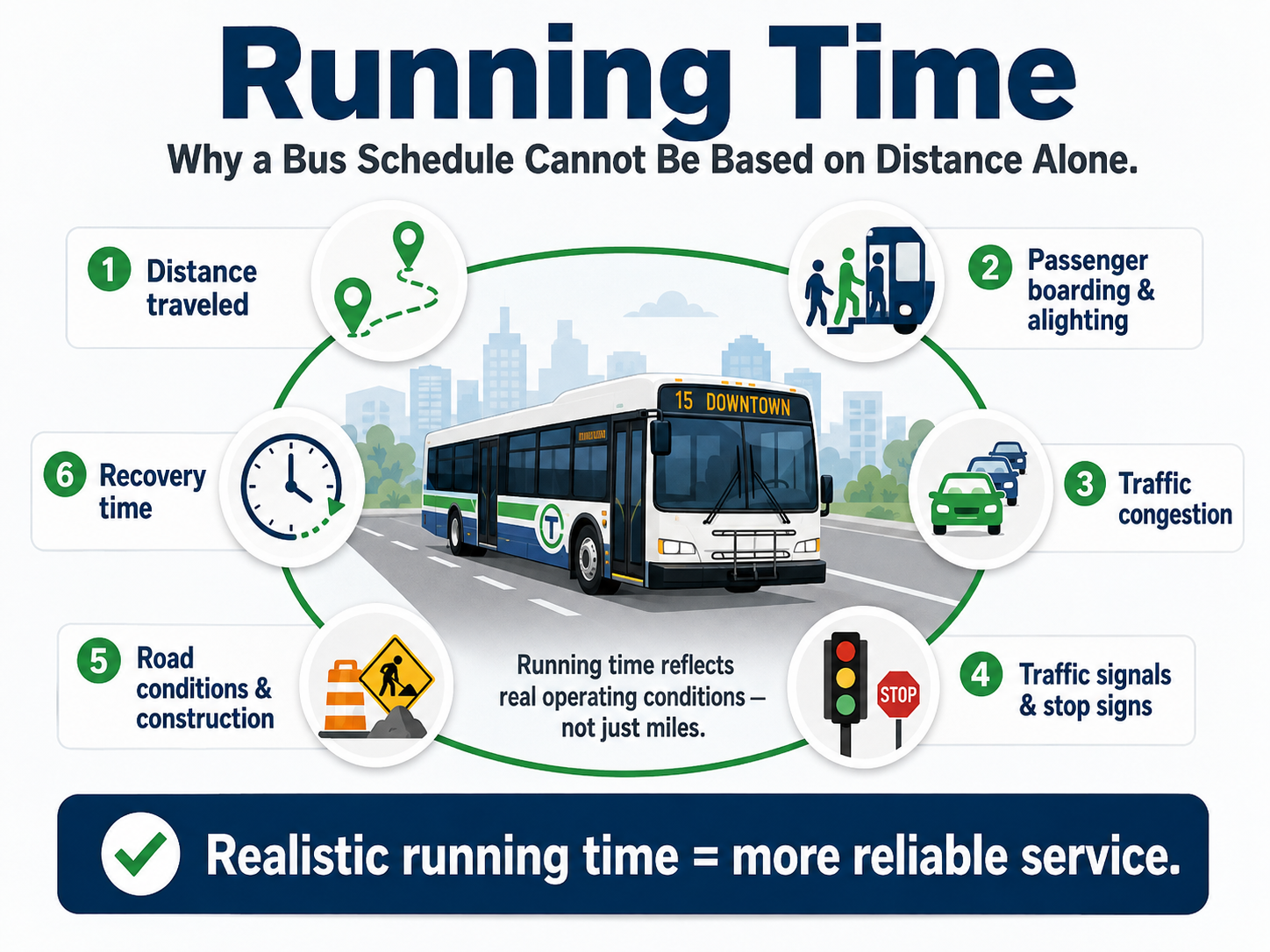
Scheduling Explained5 min read
Running Time: Why a Bus Schedule Cannot Be Based on Distance Alone
Excerpt: Two trips covering the same route and the same distance may need very different schedules. Running time reflects traffic, passenger activity, stop spacing, road conditions, and time of day—not simply how many miles the bus travels.
Read Article