What Is a Bus Block?
How individual passenger trips are connected into a full day of work for one vehicle
By Craig4 min read
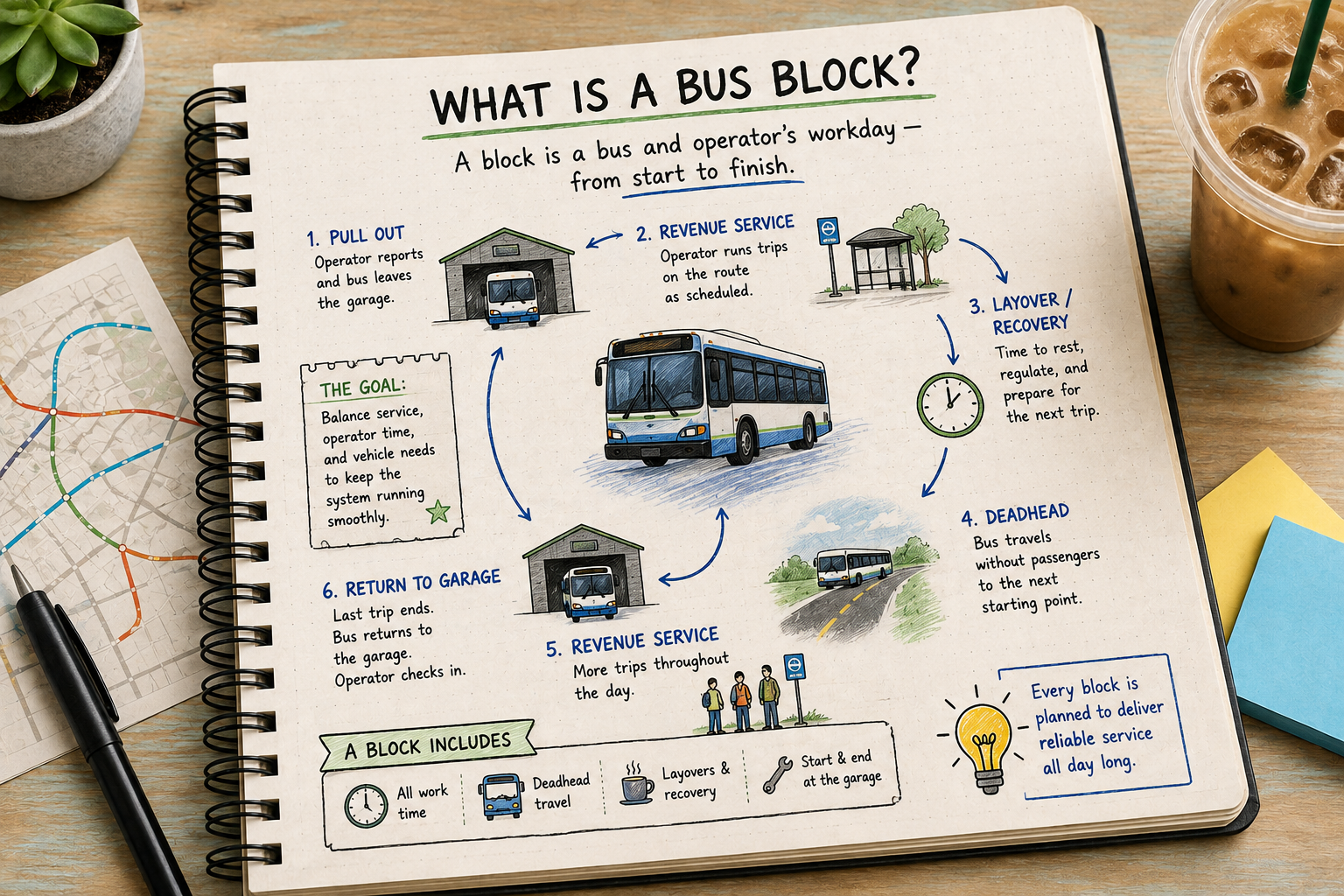
Transit terminology can be confusing because passengers, operators, dispatchers, and planners often look at the same service in very different ways.
Passengers usually think about a route.
Operators may think about their work assignment.
Schedulers also need to think about the bus itself.
What does that vehicle do from the moment it leaves the yard until it returns?
That sequence is the block.
A Trip and a Block Are Not the Same Thing
A trip is a single scheduled movement in passenger service.
For example:
A bus departs a transit center at 8:00 and reaches the end of the route at 8:45.
That is one trip.
The bus probably does not disappear at 8:45.
It may depart again at 9:00 in the opposite direction, then operate another route later in the day.
All of those activities can be connected into one block.
A Block Follows the Vehicle
The easiest way to understand a block is to imagine attaching a tracking device to one bus for the entire day.
You might see:
Bus leaves the yard.
Bus travels empty to Route A.
Bus operates an outbound trip.
Bus waits at the terminal.
Bus operates an inbound trip.
Bus changes to Route B.
Bus deadheads to another location.
Bus operates several more passenger trips.
Bus returns to the yard.
That complete sequence is the vehicle’s block.
Why Blocks Matter
A timetable tells us when passengers can ride.
A block tells operations whether the service can actually be performed by the available buses.
Good blocking attempts to use vehicles efficiently while maintaining a reliable schedule.
Poor blocking can create:
Impossible connections between trips
Excessive deadhead mileage
Inadequate recovery
Unnecessary buses
Vehicle range problems
Conflicts at transit centers
Difficult vehicle exchanges
Blocking is therefore one of the places where schedule design becomes operational reality.
Trips Must Physically Connect
Consider two trips.
Trip 1 ends downtown at 10:00.
Trip 2 begins at a transit center eight miles away at 10:05.
On a spreadsheet, it may appear that only five minutes separate the trips.
On the street, they cannot possibly be operated by the same bus.
The block must include enough time for the vehicle to travel between assignments.
This non-revenue travel is commonly called deadhead.
Deadhead Has a Cost
Deadhead is necessary, but passengers generally never see it.
A bus may travel from the operating facility to the beginning of a route, between two route assignments, or back to the yard.
That travel requires:
Operator time
Fuel or electricity
Vehicle mileage
Maintenance
Road time
Good blocking attempts to minimize unnecessary deadhead while still creating practical assignments.
In a geographically large service area, this can be particularly important.
Blocks Can Operate More Than One Route
One bus does not necessarily remain on the same route all day.
For example, demand may require additional service on one route during the morning but not during midday.
The bus might later be reassigned to another route where demand is greater.
This is known as interlining.
Interlining can improve vehicle efficiency, but it can also spread delays from one route to another.
If Route A routinely runs late and the same bus later becomes Route B, Route B may begin late through no fault of its own.
The planner has to balance efficiency with reliability.
Vehicle Type Matters
Some blocks can be operated by almost any standard bus.
Others cannot.
Vehicle suitability may depend on:
Passenger capacity
Road geometry
Fuel range
Battery range
Charging opportunities
Required equipment
Vehicle length
Terrain
Alternative-fuel fleets have made block design increasingly important.
A battery-electric bus may have sufficient range for a short urban block but not for a long intercity assignment.
The scheduler must evaluate the mileage and operating demands of the entire block rather than one individual trip.
Blocks and Operator Work Are Related but Different
A block follows the bus.
A run or operator assignment follows the employee.
Those are not necessarily the same thing.
One long vehicle block may be operated by multiple operators during the day.
An operator may also work portions of different blocks depending on the agency’s scheduling practices.
This distinction is important.
Vehicle scheduling and operator scheduling are related processes, but they solve different problems.
Why Block Numbers Exist
Agencies typically assign identifiers to blocks.
The exact numbering system varies, but the purpose is similar: provide an operational identity for that vehicle assignment.
A block number can help operations determine:
Which trips belong together
Which bus should operate them
Where the vehicle should be
What assignment comes next
Whether a vehicle exchange is needed
For operations personnel, the block may be just as important as the route number.
When a Bus Is Exchanged
Vehicles occasionally have to be changed during the service day.
Mechanical problems, fueling issues, battery state of charge, passenger capacity, or other operational considerations may require an exchange.
When that happens, the replacement bus generally assumes the remaining work of the block.
The block continues even though the physical vehicle has changed.
That illustrates an important concept:
The block represents the work, not the individual bus.
Tags
This article reflects the author's personal experience and general industry knowledge. Agency practices, labor agreements, laws, funding requirements, and operating conditions vary.
Related Articles
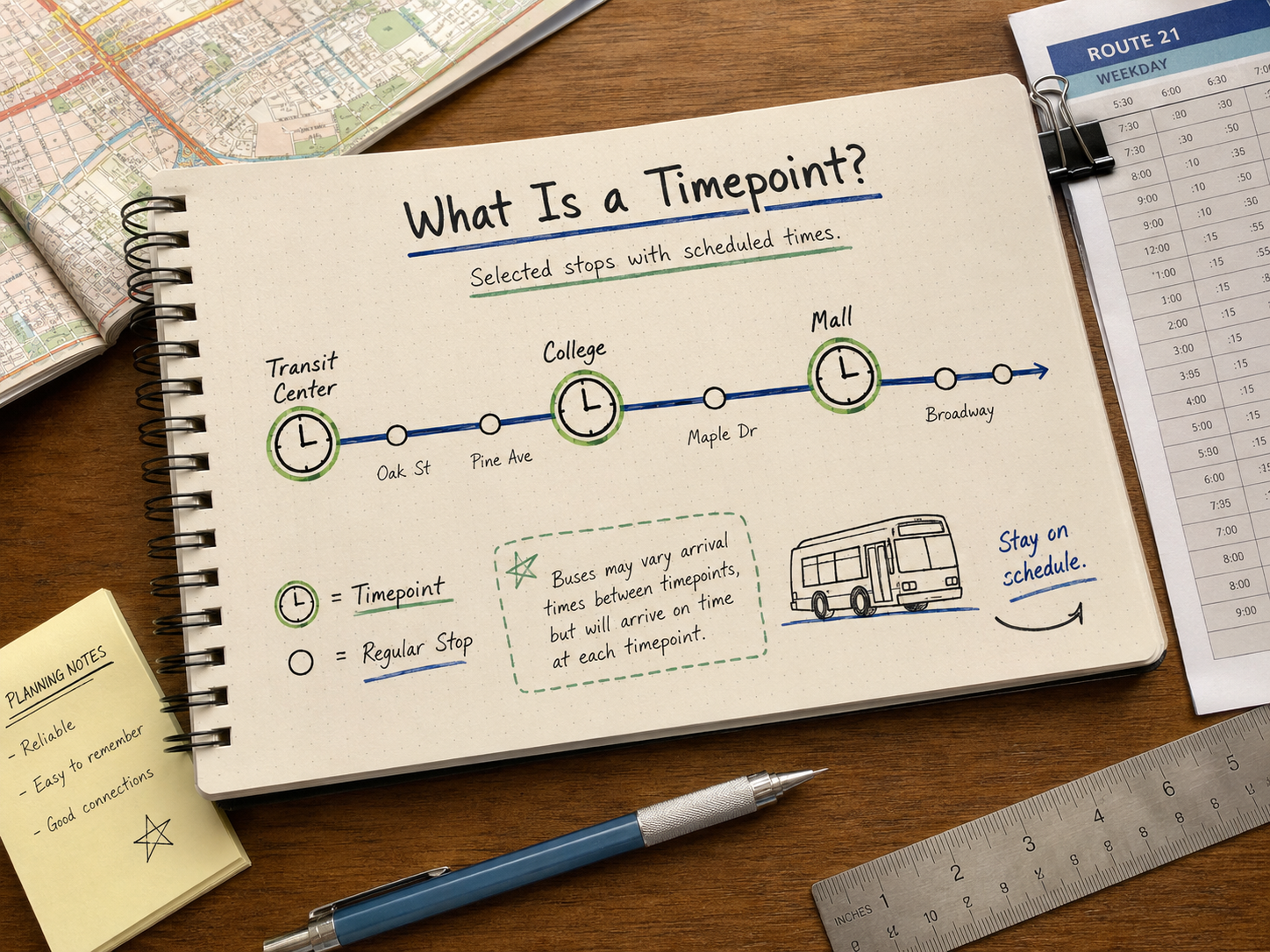
Scheduling Explained3 min read
What Is a Timepoint - and Why Doesn't Every Bus Stop Have a Scheduled Time?
A bus may serve dozens of stops while the public timetable shows scheduled times at only a handful of locations. Those locations are timepoints, and they provide the structure that keeps a route understandable to passengers and manageable for operators.
Read Article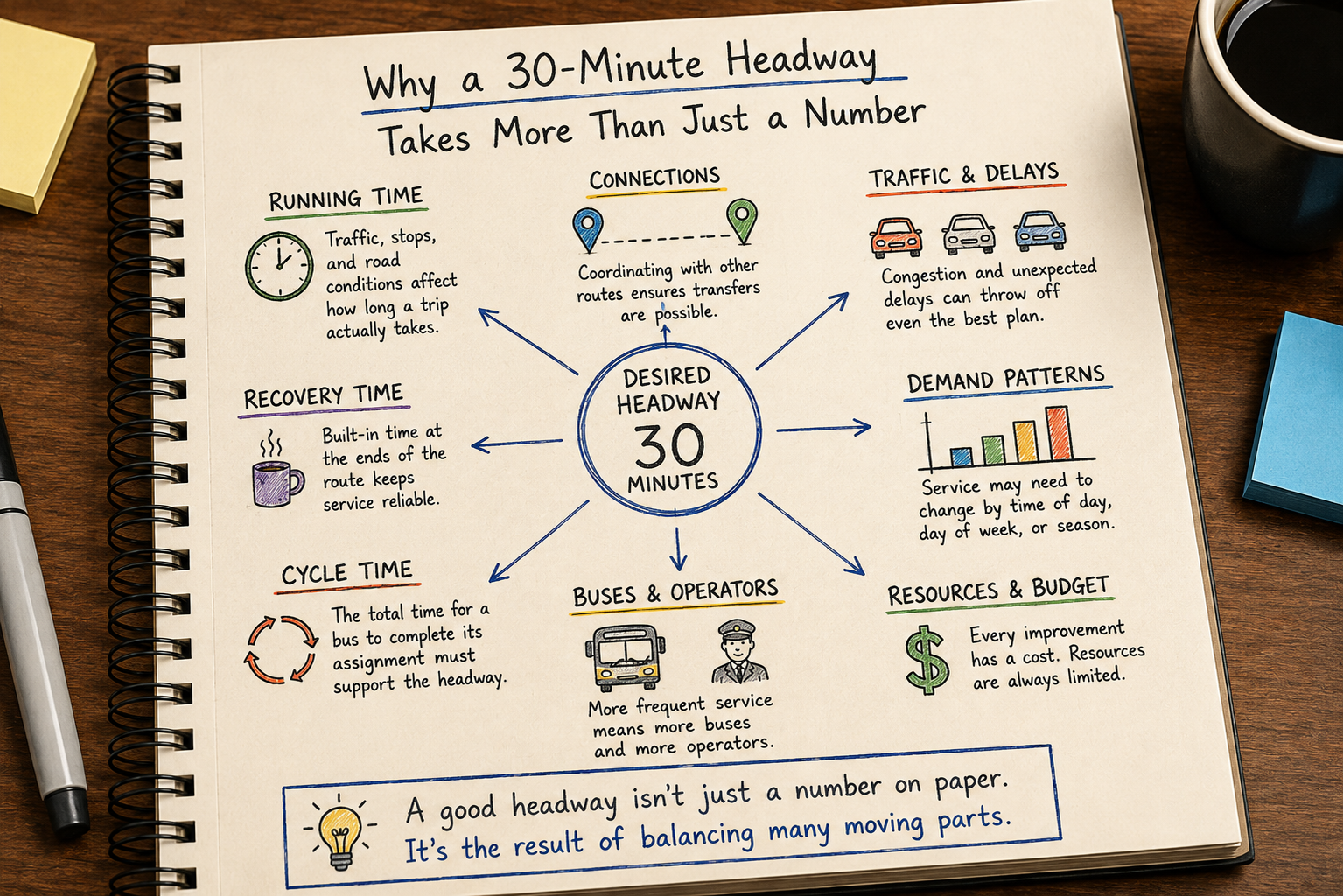
Scheduling Explained5 min read
Headways: Why “Every 30 Minutes” Is More Complicated Than It Sounds
A route that operates every 30 minutes may sound simple, but maintaining that frequency depends on running time, recovery, available buses, connections, and the overall cycle time of the route.
Read Article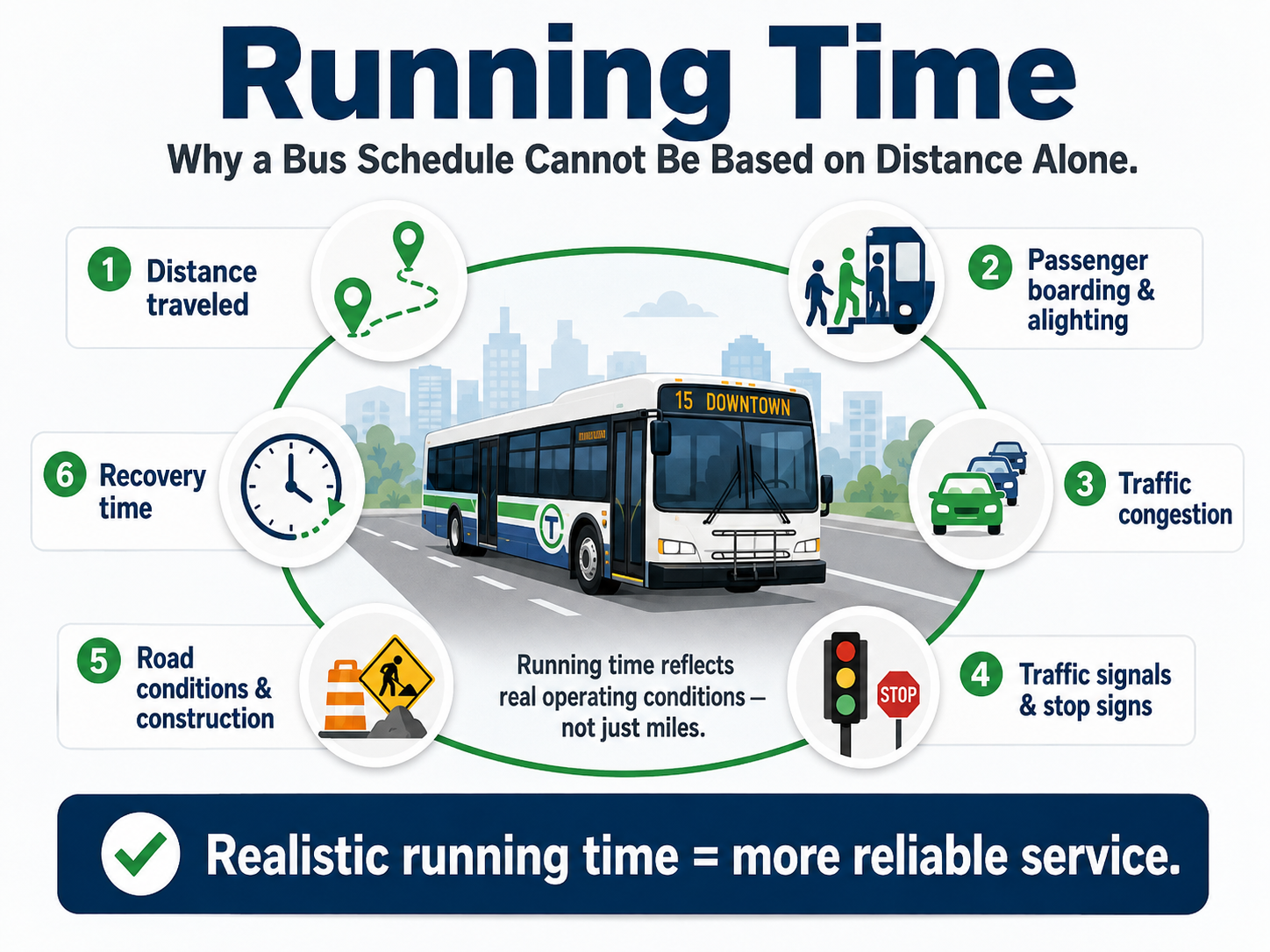
Scheduling Explained5 min read
Running Time: Why a Bus Schedule Cannot Be Based on Distance Alone
Excerpt: Two trips covering the same route and the same distance may need very different schedules. Running time reflects traffic, passenger activity, stop spacing, road conditions, and time of day—not simply how many miles the bus travels.
Read Article