Headways: Why “Every 30 Minutes” Is More Complicated Than It Sounds
How frequency, running time, connections, and vehicle requirements determine service spacing
By Craig5 min read
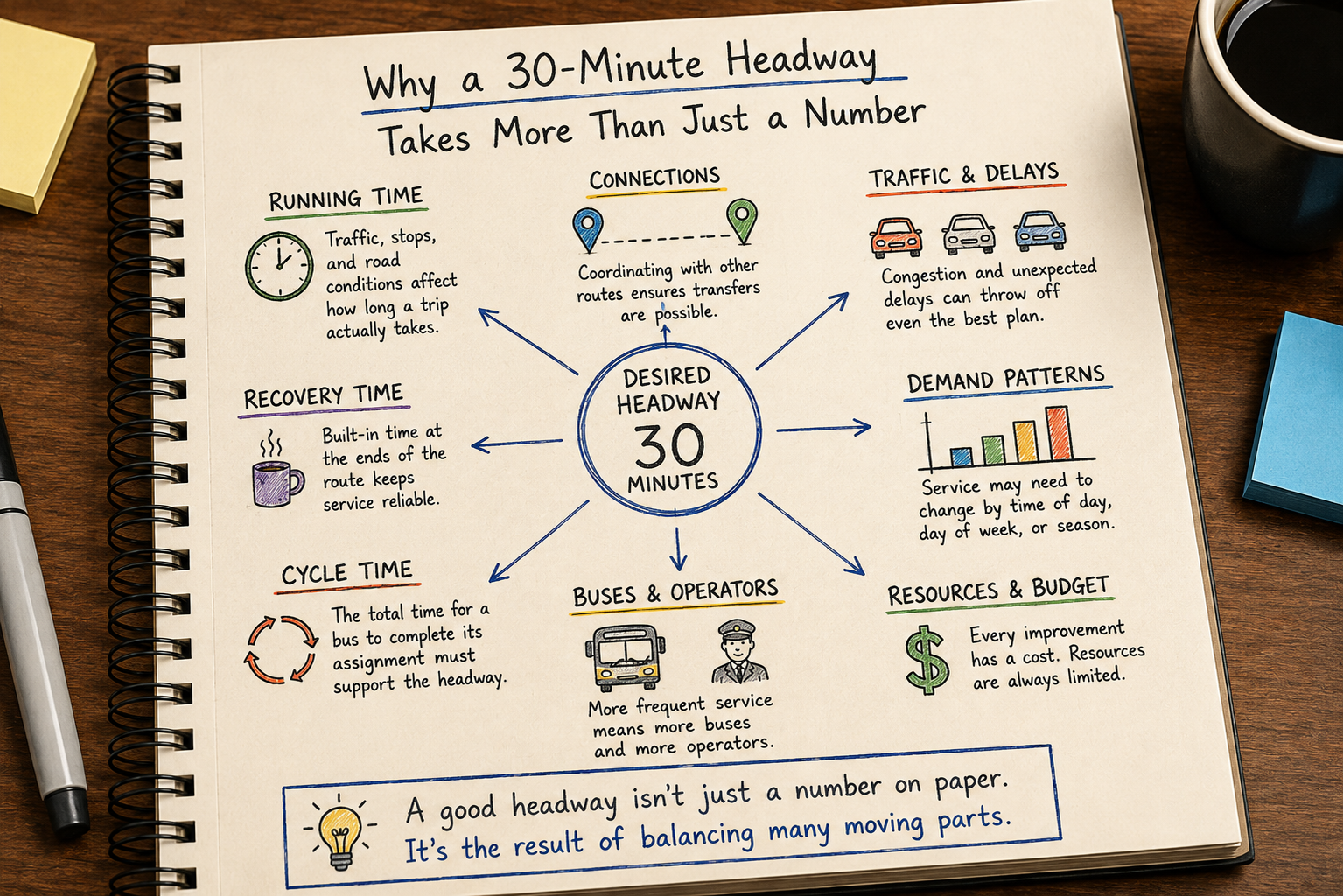
Passengers generally understand frequency better than they understand schedules.
A bus every 15 minutes sounds good.
A bus every 30 minutes sounds reasonable.
A bus every two hours sounds like a service that requires careful planning before leaving home.
The time between buses is known as the headway, and it is one of the most important characteristics of a transit service.
But creating a consistent headway is more complicated than simply selecting a number.
What Is a Headway?
A headway is the scheduled time between vehicles operating in the same direction on the same service.
If buses depart at:
- 8:00
- 8:30
- 9:00
- 9:30
the scheduled headway is 30 minutes.
Simple enough.
The difficulty comes when the planner has to make the rest of the schedule fit that pattern.
Frequency Requires Vehicles
Assume a complete round trip, including recovery, requires 120 minutes.
If the desired headway is 60 minutes:
120 ÷ 60 = 2 buses.
If the desired headway is 30 minutes:
120 ÷ 30 = 4 buses.
If the desired headway is 15 minutes:
120 ÷ 15 = 8 buses.
Reducing the headway does not merely create additional departure times. It can dramatically increase the number of vehicles and operators required.
Cycle Time Is Critical
The total time required for a bus to complete its repeating assignment is often called cycle time.
That may include:
- Outbound running time
- Terminal recovery
- Inbound running time
- Recovery at the opposite end
For a clean repeating schedule, the cycle time ideally works well with the desired headway.
Suppose the cycle takes exactly 120 minutes and the headway is 30 minutes.
That works cleanly with four buses.
But what happens if realistic running times increase the cycle to 130 minutes?
Four buses operating every 30 minutes provide only 120 minutes of cycle time.
Something has to change.
Options may include:
- Adding a fifth bus
- Increasing the headway
- Reducing recovery
- Changing running time if justified
- Adjusting the route
- Using an uneven schedule
This is where a simple public request for “every 30 minutes” becomes a scheduling problem.
When the Desired Headway No Longer Fits
It is tempting to preserve a 30- or 60-minute headway because those numbers are easy for passengers to understand.
Sometimes operating conditions no longer allow it.
In one real-world weekday service example, routes had long been built around 60- and 30-minute scheduling patterns. Over time, traffic congestion and development increased to the point that buses could no longer reliably complete the route and receive adequate recovery within those cycles.
The schedule still looked neat on paper.
The street told a different story.
On-time performance had fallen into the mid-60 percent range, and operating data showed that the problem was not simply isolated late trips. The available cycle time was no longer realistic for the conditions buses were encountering.
After a detailed review, the schedules were changed from 60- and 30-minute patterns to 70- and 35-minute patterns.
That meant giving up the cleaner clock-face schedule.
The result was substantial.
Within about a month, on-time performance increased to approximately 85 percent. Since then, monthly performance has generally remained in the 85–87 percent range.
Ridership also increased slightly after the service became more dependable. That does not prove the schedule change alone caused the increase, but improved reliability likely helped make the service easier for passengers to use with confidence.
The lesson is important:
A mathematically attractive headway has little value if the buses cannot actually maintain it.
Clock-Face Scheduling
Passengers generally benefit from predictable departure times.
A route that leaves at:
:00 and :30 every hour
is easier to remember than one departing at:
8:05, 8:40, 9:15, 9:50.
This repeating pattern is commonly called clock-face scheduling.
It works especially well on lower-frequency routes where passengers plan around a timetable.
However, preserving a perfectly repeating pattern sometimes requires compromises elsewhere in the schedule.
The real-world example above illustrates that tradeoff clearly. A 60/30 pattern was easier to remember, but it was no longer realistic. Moving to 70/35 reduced the neatness of the timetable while improving the service passengers actually received.
Connections Can Affect Headways
Transit routes do not operate independently.
At a transit center, several routes may be designed to arrive near the same time so passengers can transfer.
This can create a pulse system.
For example, several routes might arrive shortly before the hour and depart shortly afterward.
That makes transfers convenient, but it can constrain departure times.
Changing one route by ten minutes may disrupt connections with several others.
A schedule that appears better when viewed by itself may therefore be worse for the network.
Uneven Headways Are Sometimes Intentional
Not every route operates at perfectly even intervals.
There may be good reasons.
Additional trips may be added during:
- School release periods
- Commute peaks
- Major shift changes
- Special events
- Periods of heavy passenger demand
The base service might operate every 60 minutes, with one extra trip inserted during a particularly busy period.
That creates uneven spacing, but it may place capacity where it is needed most.
The question is whether the irregularity provides enough benefit to justify making the timetable less predictable.
Long Headways Increase the Importance of Reliability
On frequent urban service, missing one bus may mean waiting another ten minutes.
On a route operating every hour, the consequences are greater.
On a route operating every two hours, an early departure or missed connection can seriously affect a passenger’s day.
This is why schedule adherence is particularly important on lower-frequency service.
Passengers need confidence that the departure shown in the timetable actually means something.
Headways Versus Timetables
Very frequent services may be managed primarily by headway.
Passengers may not care whether the bus arrives at 10:07 or 10:09 if another bus is expected shortly.
On lower-frequency routes, the exact schedule becomes much more important.
Many transit systems operate a mixture of both.
The planner must therefore determine whether the primary goal is:
- Maintaining even spacing
- Meeting published times
- Protecting connections
- Or some combination of all three
The Cost of Improving Frequency
Frequency improvements are among the most valuable service improvements an agency can make.
They reduce passenger waiting and make transit easier to use without consulting a timetable.
But improved frequency is expensive because it often requires additional buses and operators throughout the service day.
Moving from hourly to 30-minute service may approximately double the vehicle requirement on a route.
That does not mean agencies should avoid frequency improvements.
It means those improvements must be planned and funded realistically.
Reliability Can Be More Valuable Than a Cleaner Headway
A scheduled 30-minute frequency looks better on paper than a 35-minute frequency.
But if the 30-minute schedule regularly produces late buses, missed connections, lost recovery, and uneven service, the passenger may actually receive a poorer product.
A slightly less frequent service that arrives when passengers are told it will arrive can be more useful than a more frequent timetable that cannot consistently be operated.
That is one of the harder lessons in transit scheduling:
The fastest or cleanest-looking schedule is not necessarily the best schedule. The best schedule is one the system can reliably deliver.
Tags
This article reflects the author's personal experience and general industry knowledge. Agency practices, labor agreements, laws, funding requirements, and operating conditions vary.
Related Articles
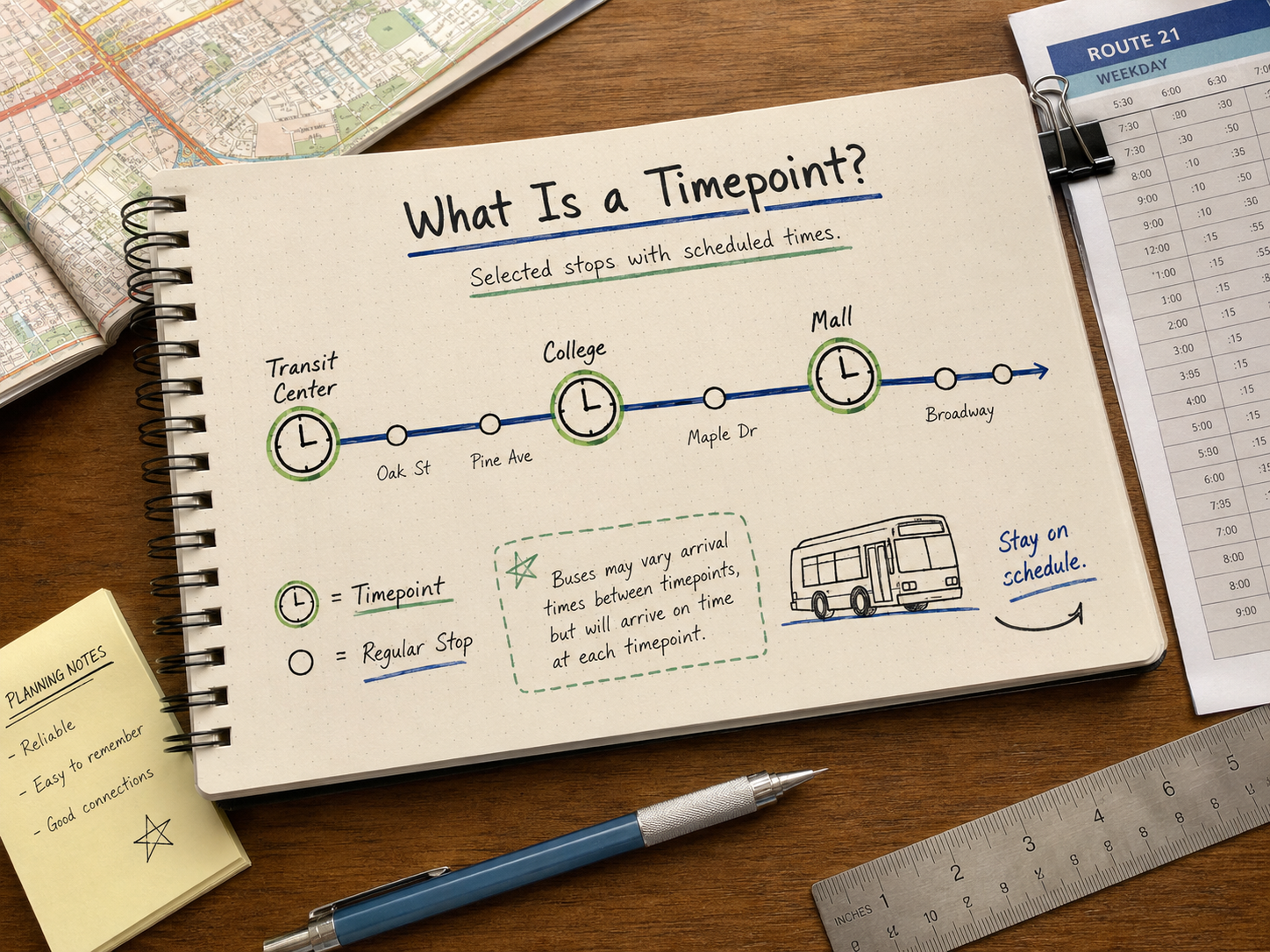
Scheduling Explained3 min read
What Is a Timepoint - and Why Doesn't Every Bus Stop Have a Scheduled Time?
A bus may serve dozens of stops while the public timetable shows scheduled times at only a handful of locations. Those locations are timepoints, and they provide the structure that keeps a route understandable to passengers and manageable for operators.
Read Article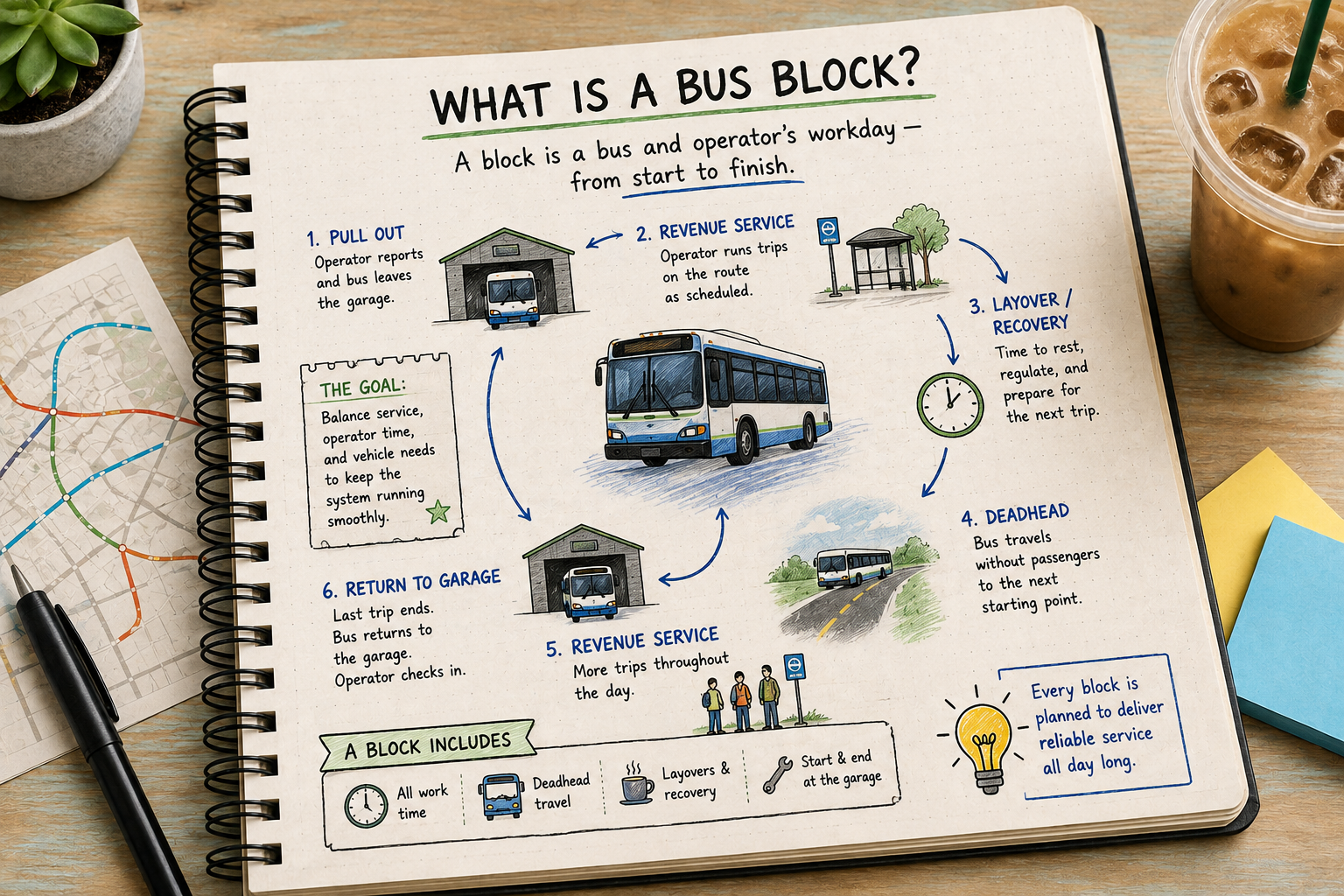
Scheduling Explained4 min read
What Is a Bus Block?
Passengers see routes and trips, but planners must also determine what each bus does throughout the day. A block connects individual trips, deadhead movements, layovers, and vehicle requirements into one continuous operating assignment.
Read Article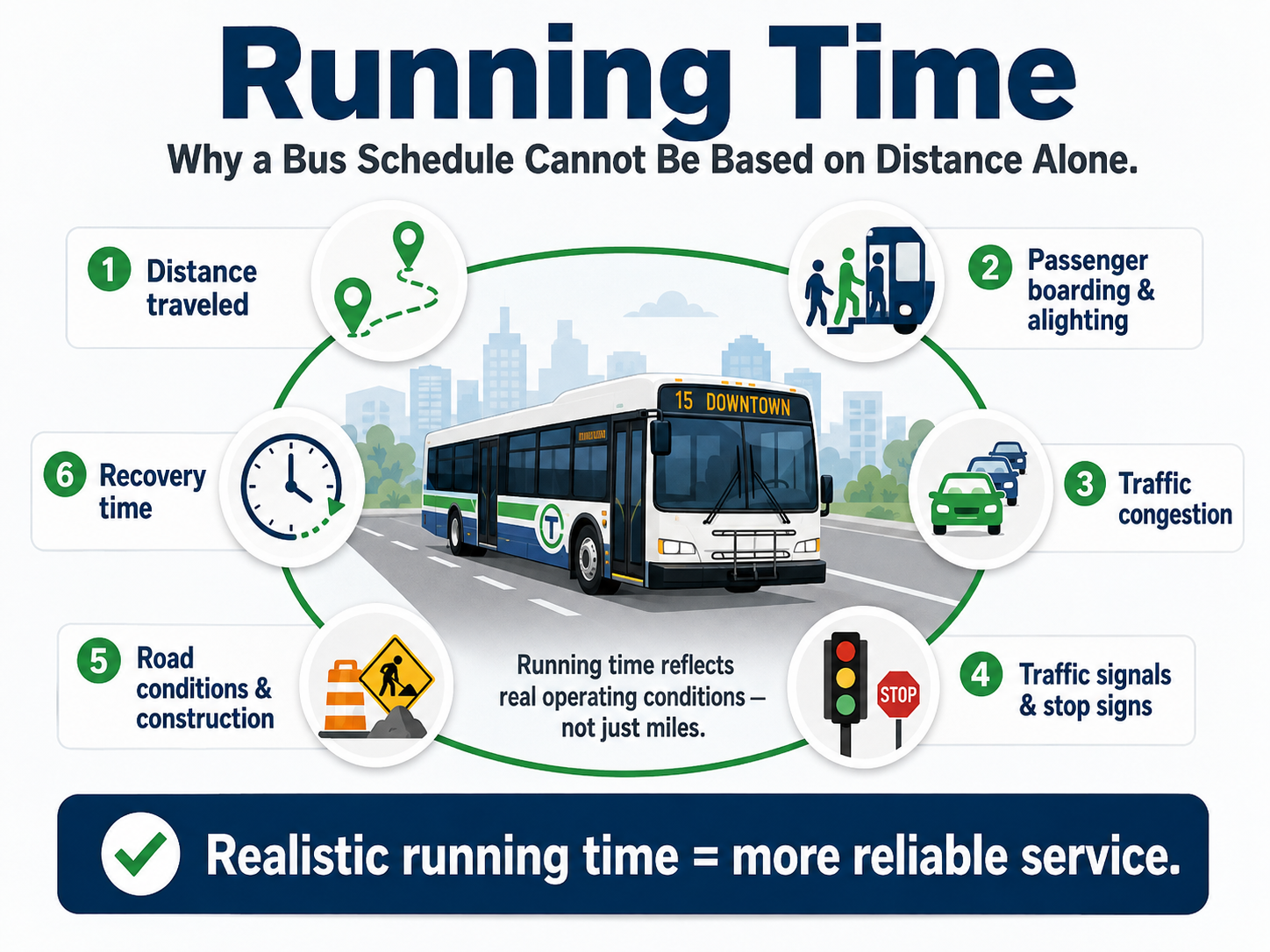
Scheduling Explained5 min read
Running Time: Why a Bus Schedule Cannot Be Based on Distance Alone
Excerpt: Two trips covering the same route and the same distance may need very different schedules. Running time reflects traffic, passenger activity, stop spacing, road conditions, and time of day—not simply how many miles the bus travels.
Read Article