Why Can’t a Bus Stop Just Be Put Here?
The safety, accessibility, roadway, and operational considerations behind bus stop placement
By Craig4 min read
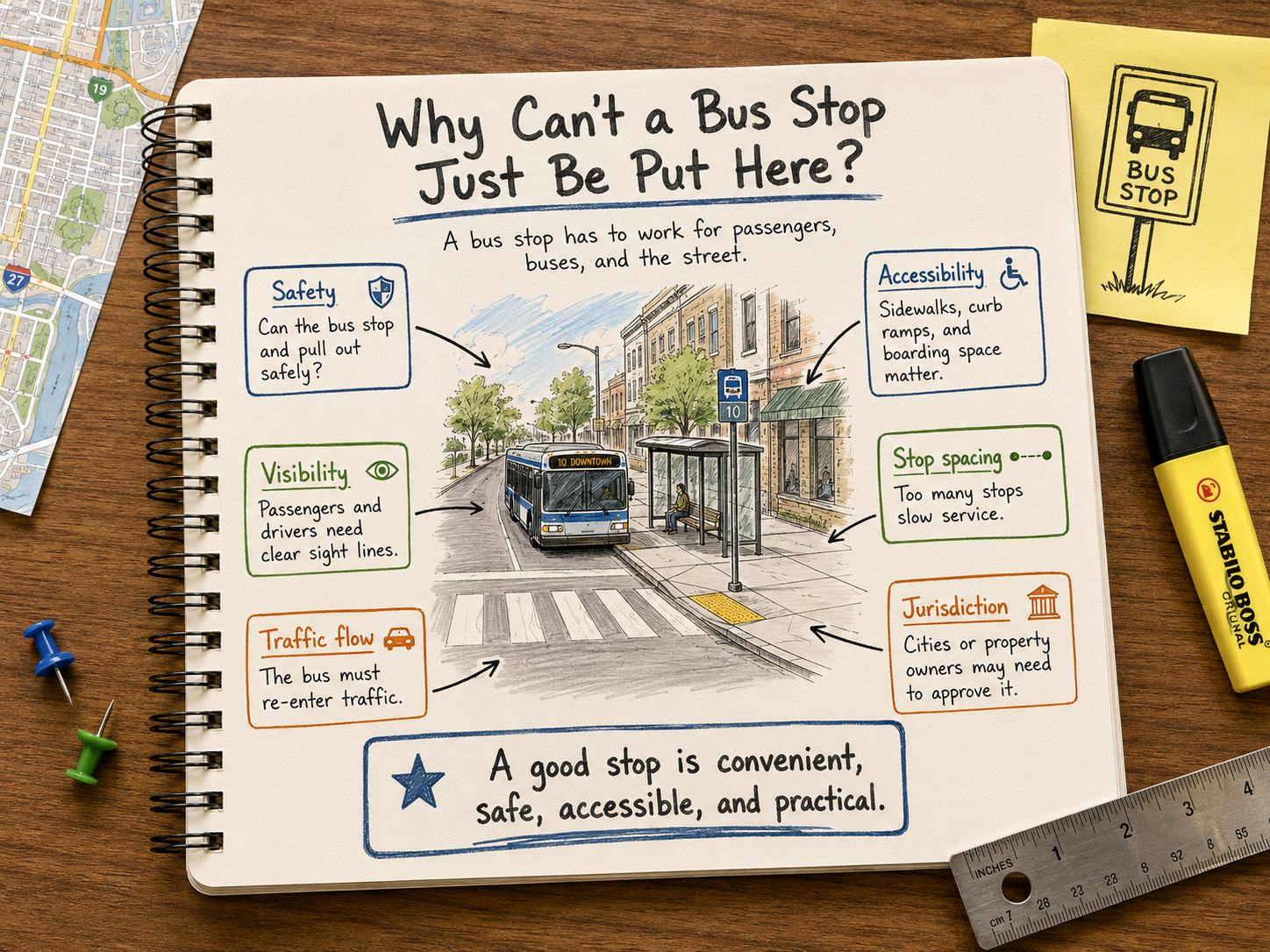
A passenger contacts the transit agency with what seems like a simple request:
“Can you put a bus stop in front of my apartment complex?”
The location may appear convenient.
The bus already travels past it.
There is space along the curb.
Why not install a sign and start stopping there?
Because a bus stop is part of the transportation infrastructure, and its location affects passengers, operators, traffic, accessibility, and safety.
Convenience Is Only the Beginning
Passenger convenience matters.
Transit should place stops where people actually need to travel.
But convenience must be evaluated alongside several other considerations.
A potential bus stop may need to be reviewed for:
Safe pedestrian access
Sight distance
Traffic speed
Roadway width
Intersection location
Curb conditions
Sidewalk availability
ADA accessibility
Drainage
Parking restrictions
Bus maneuverability
Distance from adjacent stops
Passenger activity
Property ownership
Local jurisdiction requirements
A location can be convenient while still being unsuitable.
The Passenger Must Be Able to Reach the Stop
The bus may be able to stop safely, but can the passenger reach it?
A stop without a sidewalk may require passengers to walk along a shoulder.
A stop across from a destination may force passengers to cross a high-speed roadway without a signal or crosswalk.
A stop near an intersection may place passengers where drivers do not expect pedestrians.
Transit access does not end at the curb.
The walking path to and from the stop matters.
The Bus Has to Leave Again
People naturally focus on whether a bus can pull over.
Planners also need to consider whether it can safely reenter traffic.
A stop located immediately before a busy intersection may create problems if the bus needs to cross several lanes after serving passengers.
A stop located immediately after a turn may not provide enough distance for the bus to align with the curb.
Parked vehicles may prevent the bus from approaching properly.
Road geometry matters.
Near-Side, Far-Side, and Midblock Stops
Bus stops are often categorized by their relationship to an intersection.
A near-side stop is located before the intersection.
A far-side stop is located after the intersection.
A midblock stop is located between intersections.
Each has advantages and disadvantages.
For example, a far-side stop may allow the bus to pass through an intersection before boarding passengers, but the available curb space may be limited.
A near-side stop may provide convenient access but can interact with right-turning traffic.
There is no universal answer.
The correct location depends on the street.
Stop Spacing Matters
More stops provide shorter walking distances.
Fewer stops generally allow buses to travel faster.
This creates an ongoing planning tradeoff.
Stops placed very close together can increase:
Travel time
Dwell time
Acceleration and braking
Passenger ride time
Schedule variability
Stops placed too far apart can make transit difficult to access, particularly for older adults and passengers with mobility limitations.
Good stop spacing attempts to balance accessibility and operating speed.
Accessibility Must Be Considered
A stop should provide an appropriate boarding and alighting area whenever possible.
Passengers using wheelchairs, walkers, or other mobility devices need sufficient space to board safely.
A sign pole alone does not make a stop accessible.
Sidewalk conditions, slopes, obstructions, landing areas, and connections to the surrounding pedestrian network all matter.
Improving stop accessibility can also require coordination with public works departments or other jurisdictions.
Transit Agencies Do Not Always Own the Road
This is another part of the process passengers rarely see.
The transit agency may operate the bus, but the street may belong to:
A city
A county
A state transportation department
A private property owner
Another public agency
Installing a stop can therefore require approval from an outside organization.
A bench, shelter, concrete pad, curb modification, or parking restriction may require additional permits and coordination.
From the passenger’s perspective, it is one transit stop.
Administratively, several organizations may be involved.
Bus Stops Also Need Maintenance
Once a stop is established, the work continues.
Depending on local responsibilities, stop maintenance may include:
Replacing damaged signs
Removing graffiti
Repairing shelters
Maintaining benches
Clearing vegetation
Correcting accessibility issues
Updating route information
Relocating stops during construction
A transit agency may have hundreds or thousands of stops.
Managing them is an ongoing infrastructure program, not a one-time installation.
Temporary Stops and Construction
Road construction frequently affects transit stops.
A stop may become inaccessible because of:
Lane closures
Sidewalk reconstruction
Utility work
Detours
Special events
The agency may need to establish a temporary stop nearby.
The temporary location still needs to be safe and understandable to passengers.
Communication becomes particularly important because regular riders may instinctively go to the normal stop.
The Best Stop Is Not Always the Closest Stop
A passenger may prefer a stop directly in front of a destination.
The safest and most reliable location might be 300 feet away.
That additional walking distance may provide:
A signalized crossing
A wider sidewalk
Better visibility
More curb space
Safer bus maneuvering
Transit planning often involves these compromises.
The objective is not simply to minimize walking distance. It is to provide usable access safely.
Tags
This article reflects the author's personal experience and general industry knowledge. Agency practices, labor agreements, laws, funding requirements, and operating conditions vary.