What Does a Transit Planner Actually Do?
The planning, scheduling, data, and coordination behind everyday bus service
By Craig4 min read
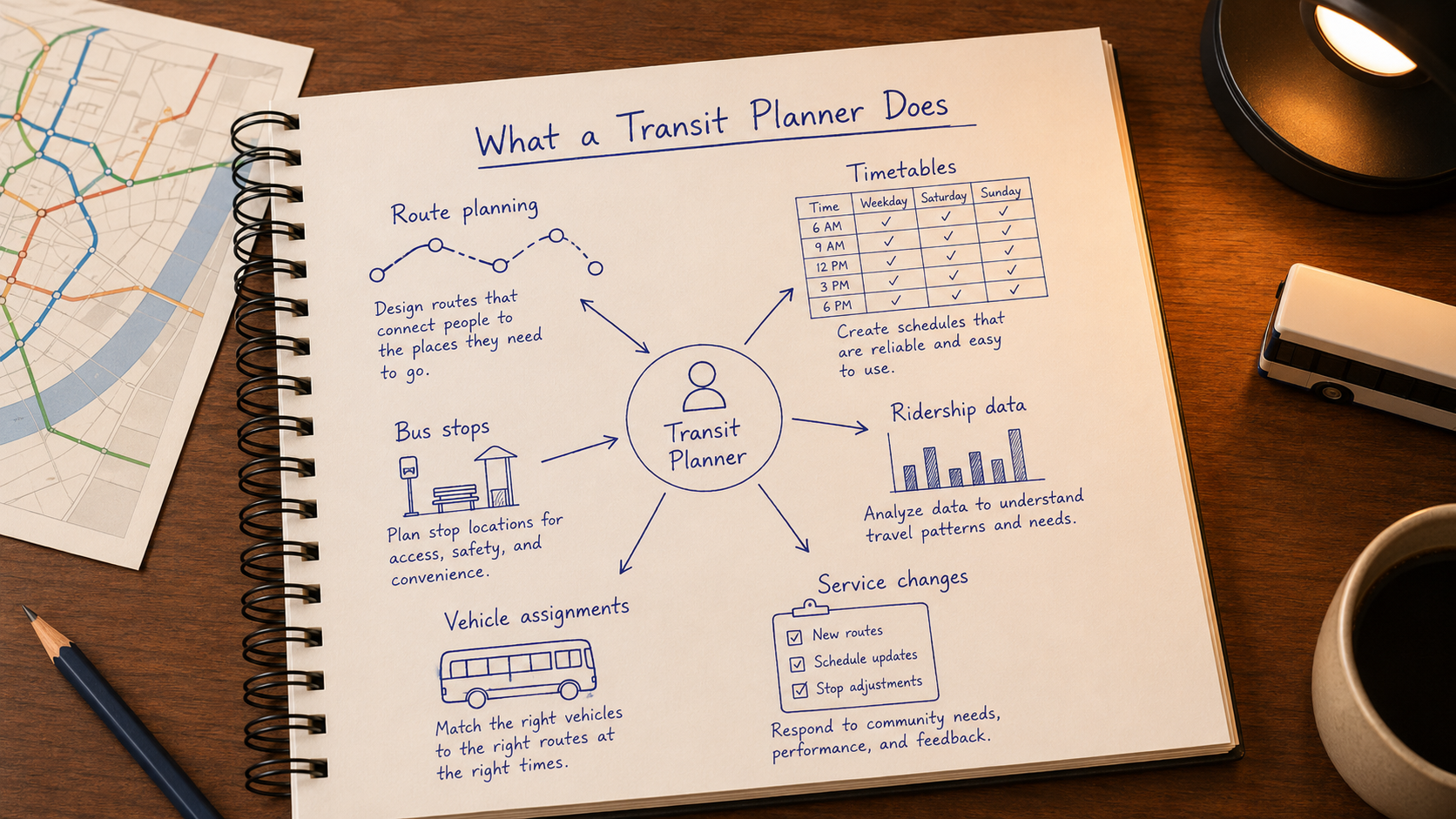
When most people think about public transit, they picture a bus, a driver, a bus stop, and perhaps a timetable. Those are the visible parts of the system. What passengers usually do not see is the planning work required before a bus ever pulls away from the curb.
A transit planner helps turn community needs, operating resources, funding limitations, road conditions, and policy decisions into a service that can actually be operated.
That sounds straightforward. It rarely is.
More Than Drawing Lines on a Map
One of the most visible parts of transit planning is route design. A planner may review whether a route should serve a particular neighborhood, shopping center, college, medical facility, employment area, or transit center.
Drawing a line on a map is easy. Designing a workable route is much harder.
A proposed route must be evaluated for:
- Passenger demand
- Street access
- Safe turning movements
- Bus stop locations
- Travel time
- Operating cost
- Connections with other routes
- Vehicle suitability
- Operator and passenger safety
- Reliability throughout the day
A route may look perfectly reasonable on a map but fail in practice because the bus cannot make a turn, traffic delays are too severe, or there is no safe place for passengers to board.
Transit planning has to work on the street, not merely on paper.
Building the Timetable
Once a route and its stops are established, the service must be scheduled.
The planner determines how long each trip should take, when buses should depart, how frequently they should operate, and how trips should connect with one another.
Running time is influenced by many factors:
- Distance
- Traffic
- Passenger activity
- Traffic signals
- School dismissal periods
- Wheelchair boardings
- Railroad crossings
- Construction
- Seasonal travel patterns
- Time of day
A trip that takes 45 minutes early in the morning may require considerably more time during the afternoon peak period. Using the same running time all day can produce a schedule that appears simple but is unreliable when traffic increases.
The planner must also add recovery time. Recovery allows the bus and operator to absorb ordinary delays before beginning the next trip. Without it, one late trip can cause every following trip to depart late.
Trips, Blocks, and Vehicle Assignments
Passengers see individual trips. Transit planners also have to see how those trips fit together over an entire operating day.
A series of trips assigned to one bus is commonly called a block. A block may begin before sunrise, operate several different route segments, include layovers and deadhead travel, and end many hours later.
The planner must make sure that:
- The bus can physically move from one trip to the next
- The arrival and departure times are compatible
- Enough time is provided between trips
- The correct vehicle type can be used
- Fuel or battery range is sufficient
- Transit-center capacity is not exceeded
- Service does not require more buses than are available
Vehicle technology has added another layer to this work. Battery-electric and hydrogen fuel-cell buses can provide important benefits, but they cannot always be assigned exactly like conventional buses.
Range, charging, fueling, weather, terrain, and block mileage all matter. A block that works well for one vehicle may not work for another.
Bus Stops Are Part of the Service
Transit planners are often involved in recommending bus stop locations, but the final responsibility may be shared with cities, counties, property owners, contractors, or other agencies.
A potential stop must be evaluated for:
- Pedestrian access
- Roadway conditions
- Visibility
- Available space
- Nearby intersections
- Accessibility
- Passenger safety
- Distance from other stops
- Operational impact
A stop cannot be placed simply because someone requests one at a convenient location. The bus must be able to approach it safely, passengers must be able to reach it, and the surrounding jurisdiction may need to approve it.
The physical stop is also only one part of the system. Signs, poles, shelters, benches, pavement, lighting, and accessibility improvements may be handled by different organizations.
To the passenger, it is all one bus stop. Administratively, it may involve several separate responsibilities.
Data and Service Evaluation
Transit planning does not end when the timetable is published.
Planners review ridership, running times, on-time performance, passenger comments, operator feedback, missed trips, overcrowding, and other service information.
A route may need to be adjusted because:
- Passenger demand has shifted
- A major employer has changed work hours
- A school schedule has changed
- Construction affects travel time
- A new development has opened
- Connections are regularly being missed
- Certain trips carry very few or very many passengers
- The existing timetable no longer reflects actual conditions
Data is essential, but it does not make the decision by itself. Numbers must be interpreted with an understanding of the community and the operating environment.
A low-ridership trip, for example, may still provide an essential connection for workers, students, older adults, or passengers with limited transportation alternatives.
Planning and Operations Are Different-but Connected
There is often confusion between planning and day-to-day operations.
Planning generally establishes the route structure, timetables, service levels, blocks, stops, and longer-term operating requirements.
Operations handles the daily task of putting service on the street. That includes assigning operators and vehicles, responding to delays, handling detours, covering absences, managing incidents, and making real-time decisions.
Neither side can succeed alone.
A schedule that looks good in an office but cannot be operated is not a good schedule. At the same time, daily operational decisions work best when they are supported by realistic routes, adequate running time, and clear service standards.
Tags
This article reflects the author's personal experience and general industry knowledge. Agency practices, labor agreements, laws, funding requirements, and operating conditions vary.