From Route Map to Daily Bus Assignment: How a Transit Schedule Is Built
How routes, running times, frequency, recovery, blocks, and vehicle assignments come together
By Craig5 min read
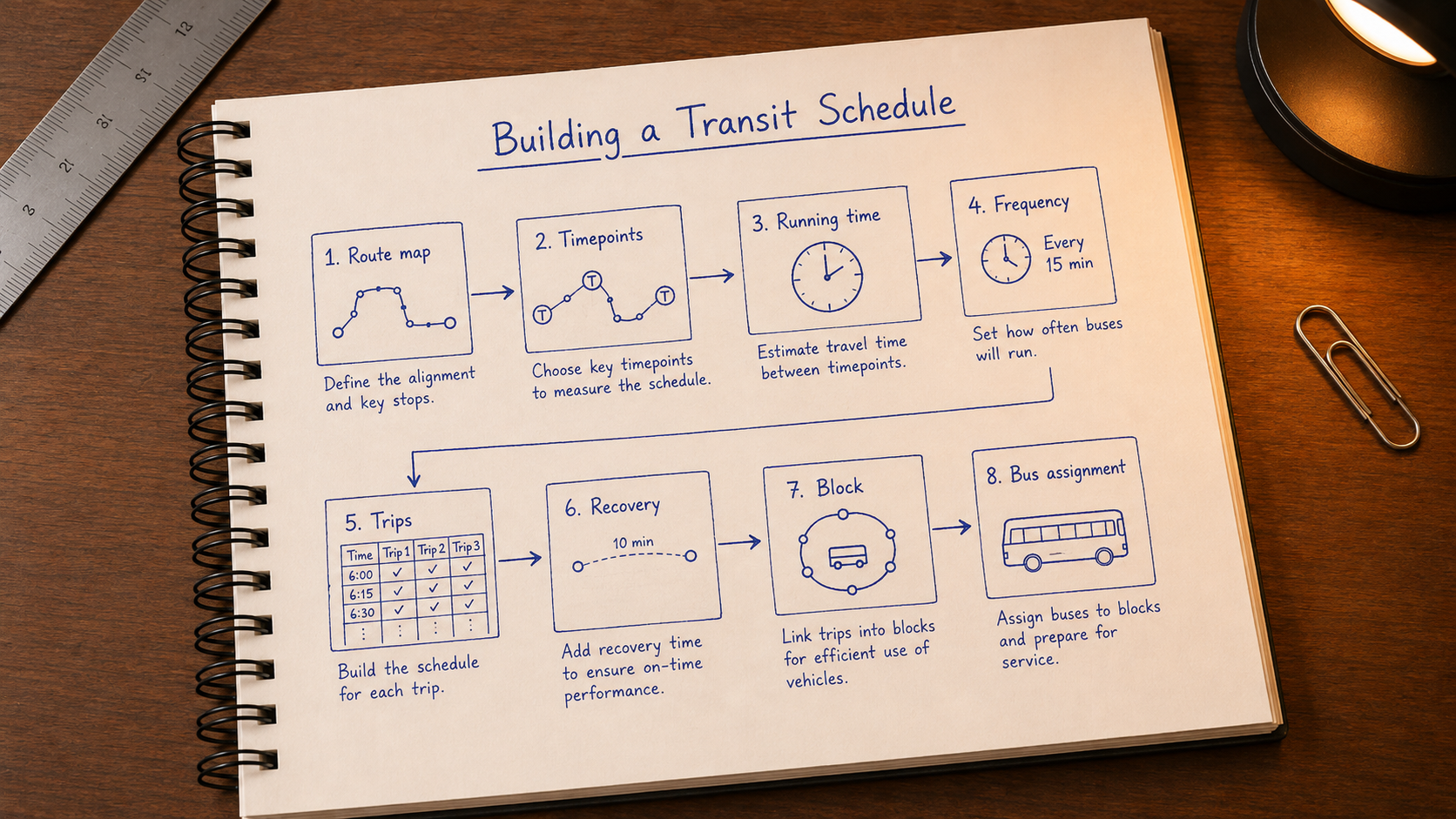
A transit timetable may look like a simple list of departure times. Behind that list is a detailed process involving route design, running-time analysis, service frequency, vehicle assignments, recovery time, and operating constraints.
Building a schedule is not merely a matter of deciding that a bus should leave every hour.
The service must fit together from the first trip of the morning until the final bus returns to the yard.
Step 1: Define the Purpose of the Route
Every route should serve a clear transportation purpose.
It may connect:
- Residential areas with employment centers
- Neighborhoods with shopping and medical services
- Local routes with a regional transit center
- Rural communities with a larger city
- Students with a college or university
- Passengers with commuter or intercity service
Before developing a timetable, the planner needs to understand who the route is intended to serve and when those passengers are likely to travel.
A route designed primarily for work trips may need strong early-morning and afternoon service. A route serving shopping and medical destinations may have greater demand during the middle of the day.
The schedule should reflect the actual purpose of the route.
Step 2: Establish the Route and Timepoints
The next step is defining the path the bus will follow.
The route must account for roadway access, turn restrictions, bridge clearances, congestion, construction, safety, and the location of major destinations.
Once the path is established, the planner selects timepoints.
A timepoint is a location shown in the public timetable where the bus has a scheduled time. Not every bus stop is a timepoint. A route may serve dozens of stops but show only several major locations in the timetable.
Good timepoints are usually:
- Major transit centers
- Important transfer locations
- Large activity centers
- Route terminals
- Locations spaced logically along the route
- Places passengers can easily identify
Too few timepoints make the timetable less useful. Too many make it difficult to read and can place unnecessary constraints on operations.
Step 3: Measure Running Time
Running time is the amount of time needed to travel from one location to another while providing normal passenger service.
It should not be based solely on distance or an online map estimate.
A bus route has operating conditions that a private automobile does not:
- Frequent stops
- Passenger boarding and alighting
- Wheelchair securement
- Lower acceleration
- Wider turns
- Traffic-signal delays
- Transit-center circulation
- Fare collection
- Heavy passenger loads
Running time should be based on actual observations and operating data whenever possible.
It may also vary by time of day. A route can require one set of running times during the early morning, another during midday, and more time during the afternoon peak.
This is why a well-built timetable may not repeat the same travel time on every trip.
Step 4: Select the Frequency
Frequency describes how often the service operates.
Common examples include every:
- 15 minutes
- 30 minutes
- 60 minutes
- Two hours
The desired frequency must be balanced against available funding, buses, operators, and actual passenger demand.
Frequency and running time work together.
Suppose a round trip, including recovery, takes two hours. Operating every hour would generally require two buses. Operating every 30 minutes could require four.
Even a small increase in running time can change the number of buses needed. If that same round trip grows from 120 minutes to 130 minutes, a clean hourly pattern may no longer work without changing departure times or adding resources.
This is one reason schedule changes can have consequences that are not immediately obvious.
Step 5: Create the Individual Trips
Once running times and frequency are established, the planner creates the individual trips.
Each trip has:
- A route
- A direction
- A starting point
- A departure time
- Intermediate times
- An ending point
- A service day
- A unique operational identity
The planner then checks how the trips interact.
Important questions include:
- Do opposing trips meet at the right locations?
- Are transfer opportunities reasonable?
- Does one bus arrive before another must depart?
- Are transit-center bays available?
- Does the service pattern remain understandable?
- Are there unnecessary gaps or duplicate trips?
A timetable is not a collection of isolated rows. Every trip affects other parts of the system.
Step 6: Add Recovery and Layover
A bus cannot be scheduled to arrive at a terminal and immediately depart all day long.
Normal service encounters delays. Traffic changes, passenger loads vary, and some boardings take longer than others.
Recovery time gives the bus a chance to return to schedule before beginning the next trip.
Layover also provides a necessary pause for the operator. Depending on the service structure, contractual requirements, and trip length, additional break arrangements may be handled during the operator scheduling process.
The goal is balance.
Too little recovery creates chronic lateness. Too much recovery can increase cost, occupy limited terminal space, and produce unnecessary passenger waiting.
Step 7: Connect the Trips into Blocks
After the trips are created, they must be assigned to buses.
A block is the complete sequence of work performed by one vehicle during the day.
A block may contain:
- Pull-out travel from the yard
- Several passenger trips
- Deadhead movements
- Layovers
- Charging or fueling opportunities
- Route changes
- Pull-in travel to the yard
The planner must confirm that the vehicle can move between each assignment.
If one trip ends at 10:00 and the next begins several miles away at 10:02, the block does not work-even though both passenger trips may look correct when viewed separately.
Blocking is where the timetable becomes a real operating plan.
Step 8: Match the Block to the Vehicle
Not every bus can necessarily operate every block.
Vehicle assignment may depend on:
- Seating and standing capacity
- Road conditions
- Vehicle length
- Fuel type
- Battery range
- Charging availability
- Terrain
- Required equipment
- Maintenance limitations
An extended intercity block may require a different vehicle than a short local circulator.
Battery-electric bus assignments are often based on the total mileage and operating characteristics of the block. A bus may perform well on a moderate urban block but be less suitable for a long-distance assignment without a charging opportunity.
Planners therefore need to consider the entire day, not just the length of one trip.
Step 9: Test the Finished Schedule
Before implementation, the schedule should be reviewed from several perspectives.
The planner should ask:
- Can the bus physically operate the route?
- Are the running times realistic?
- Are transfers protected where practical?
- Is recovery adequate?
- Are too many buses scheduled at one location?
- Are vehicle ranges appropriate?
- Can operations understand and implement the plan?
- Is the public timetable clear?
Operator feedback can be especially valuable. Operators see recurring field conditions that may not be obvious from data alone.
After implementation, actual performance should be monitored. Even a carefully built schedule may require adjustment once it encounters real traffic, passenger behavior, and daily operating conditions.
This article reflects the author's personal experience and general industry knowledge. Agency practices, labor agreements, laws, funding requirements, and operating conditions vary.
Related Articles
Scheduling Explained3 min read
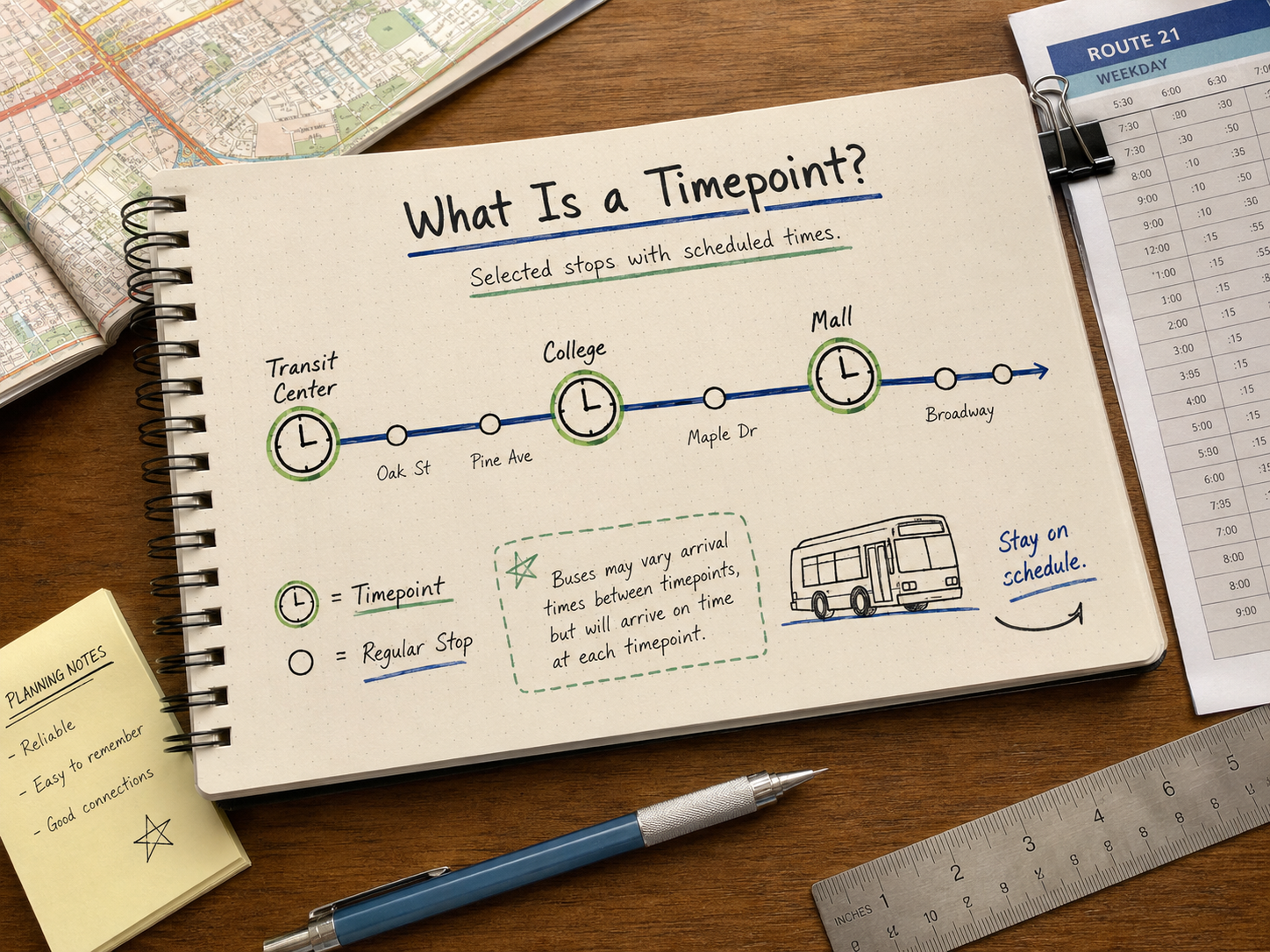
What Is a Timepoint - and Why Doesn't Every Bus Stop Have a Scheduled Time?
A bus may serve dozens of stops while the public timetable shows scheduled times at only a handful of locations. Those locations are timepoints, and they provide the structure that keeps a route understandable to passengers and manageable for operators.
Read Article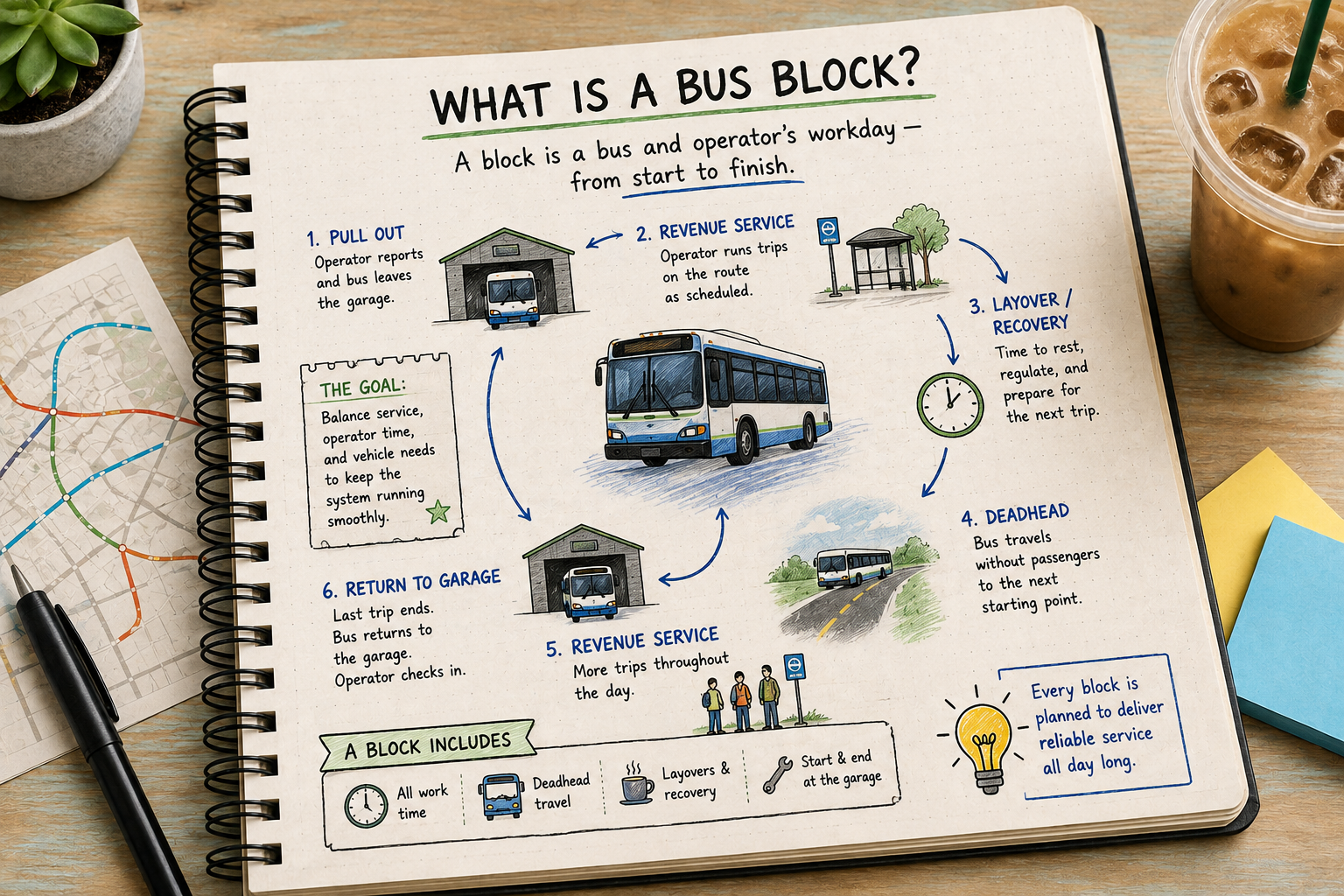
Scheduling Explained4 min read
What Is a Bus Block?
Passengers see routes and trips, but planners must also determine what each bus does throughout the day. A block connects individual trips, deadhead movements, layovers, and vehicle requirements into one continuous operating assignment.
Read Article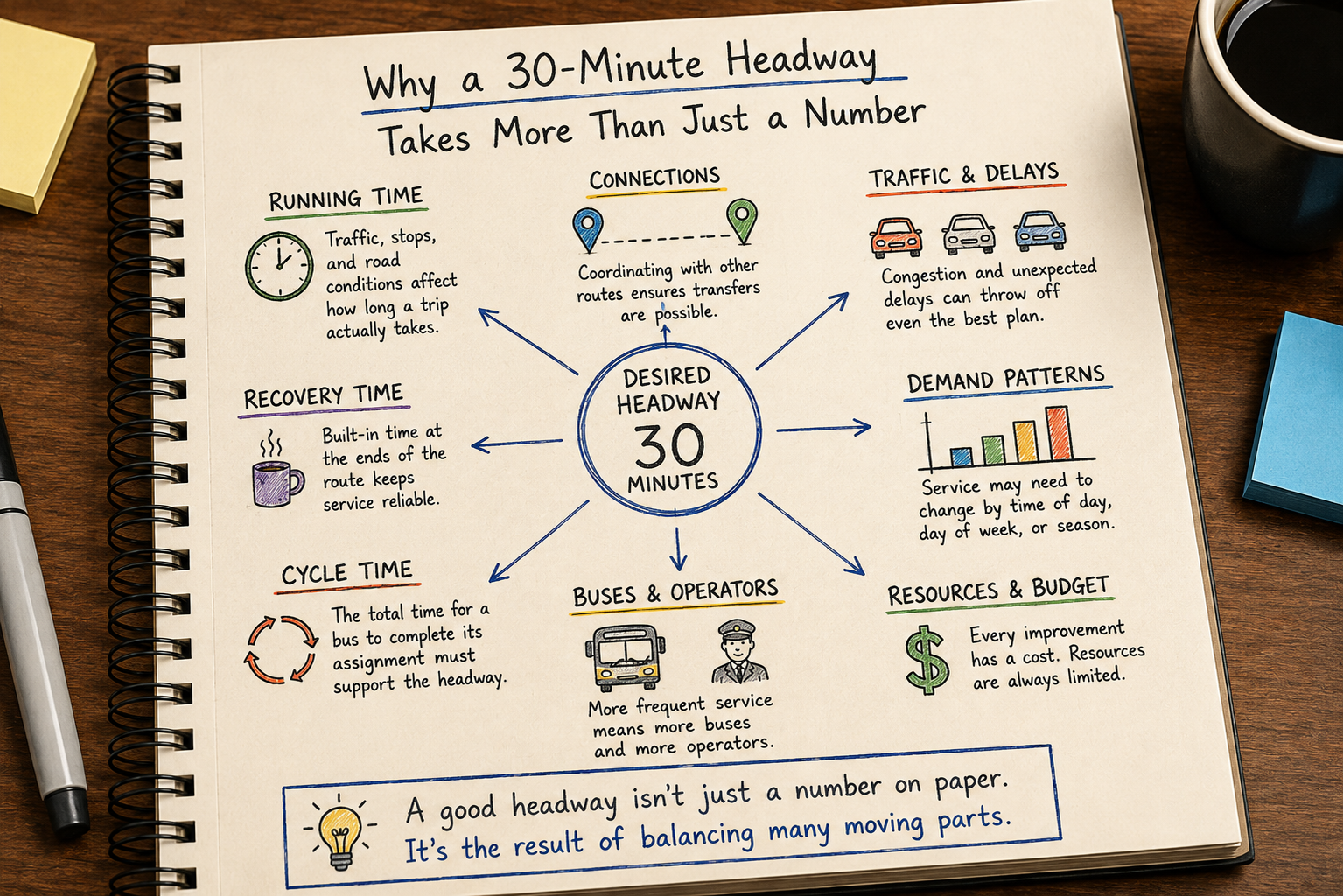
Scheduling Explained5 min read
Headways: Why “Every 30 Minutes” Is More Complicated Than It Sounds
A route that operates every 30 minutes may sound simple, but maintaining that frequency depends on running time, recovery, available buses, connections, and the overall cycle time of the route.
Read Article