Running Time: Why a Bus Schedule Cannot Be Based on Distance Alone
Traffic, passengers, stops, and time of day matter just as much as miles
By Craig5 min read
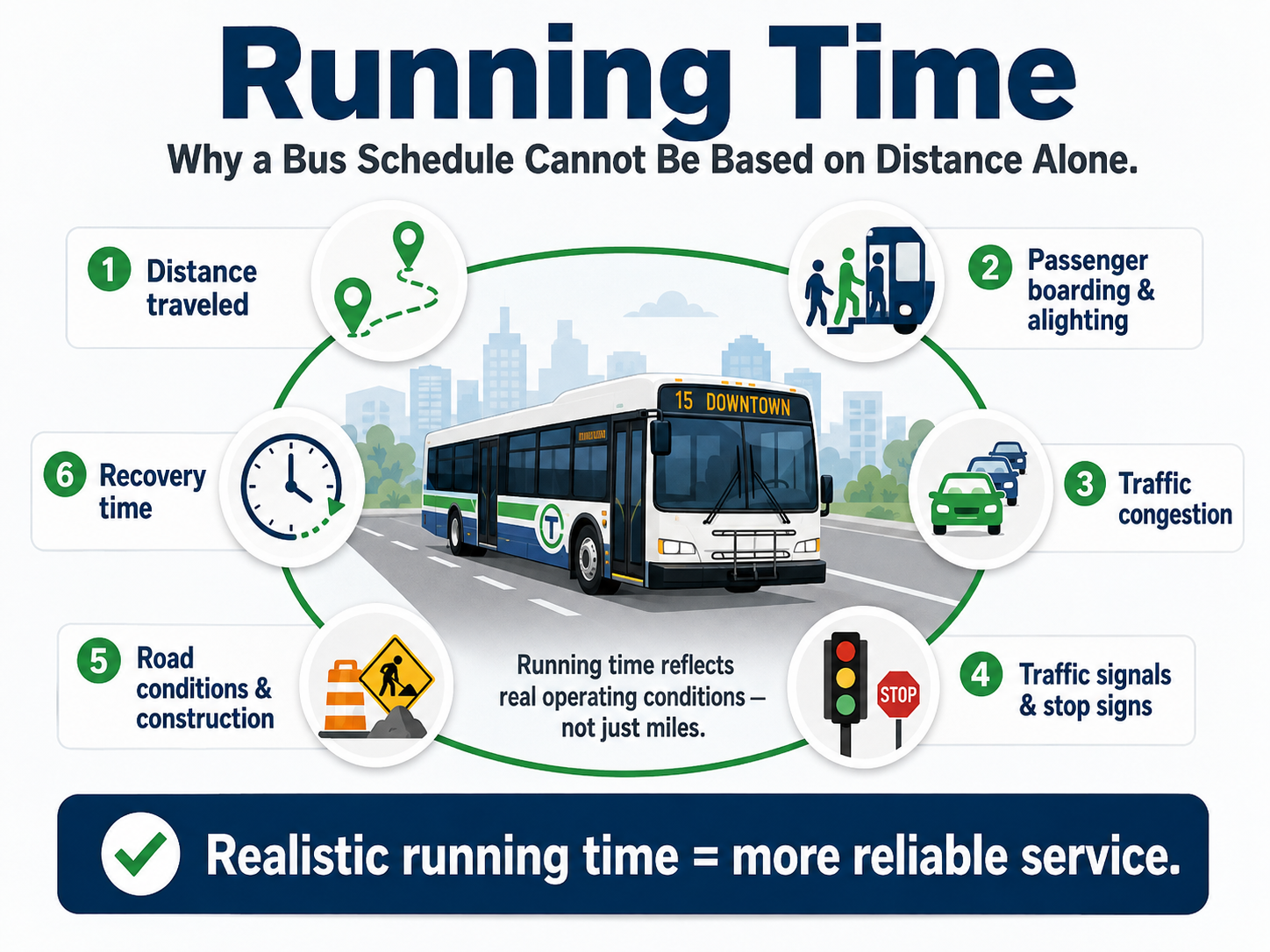
A route is 15 miles long.
A mapping program says the drive should take 30 minutes.
So the bus should be able to make the trip in 30 minutes, right?
Not necessarily.
One of the fundamental differences between planning automobile travel and scheduling public transit is that a bus is not simply driving from Point A to Point B. It is providing service throughout the trip.
That changes everything.
What Is Running Time?
Running time is the scheduled amount of time a transit vehicle is given to travel between two locations while performing normal passenger service.
That includes much more than driving.
During a typical trip, the bus may:
Stop dozens of times
Load and unload passengers
Wait at traffic signals
Serve passengers using mobility devices
Maneuver into transit centers
Deal with congestion
Merge back into traffic
Make required turns
Travel through school zones
Cross railroad tracks
Encounter construction or roadwork
Each event may add only a few seconds or minutes, but those minutes accumulate.
A 30-minute automobile trip may easily become a 45- or 50-minute transit trip.
Distance Is Only One Factor
Distance certainly matters. A 30-mile route generally requires more running time than a five-mile route.
But mileage alone tells us very little about how quickly a bus can actually operate.
Consider two ten-mile routes.
One travels primarily along a highway with widely spaced stops.
The other travels through a busy commercial corridor with traffic signals every few blocks and heavy passenger activity.
They may be nearly identical in distance but require very different schedules.
This is why simply calculating average speed from mileage can be misleading.
Passenger Activity Matters
Every boarding takes time.
A stop with one passenger may require only a few seconds. A stop with 15 passengers can take considerably longer.
Passenger activity also varies throughout the day.
A route serving a college may experience significant boarding activity immediately before and after classes. A route serving employment centers may be busiest during commute periods. Shopping areas may generate more activity during midday or weekends.
The schedule needs to reflect those patterns.
Otherwise, the bus may operate comfortably on some trips and struggle to remain on time on others.
Accessibility Is Part of Normal Running Time
Accessible service is not an unusual event. It is part of normal transit operation.
Boarding a passenger using a wheelchair or other mobility device may require deployment of a ramp, maneuvering into the vehicle, and securement.
That process takes additional time.
A schedule should not treat accessible boardings as something that never happens.
Good planning recognizes that passenger needs vary and builds reasonable operating time into the schedule.
Traffic Changes Throughout the Day
A trip that requires 35 minutes at 5:30 in the morning may require 50 minutes at 4:30 in the afternoon.
This is one reason using the same running time throughout the entire service day can be a mistake.
Transit planners often examine running times by different periods of the day.
Early morning
Morning peak
Midday
Afternoon peak
Evening
The exact periods vary by agency and service area.
The objective is to recognize that road conditions are not constant.
Too Little Running Time
An overly aggressive schedule can create serious problems.
If the timetable does not provide enough running time:
Operators begin arriving late
Passengers miss connections
Recovery time disappears
Following trips begin late
Dispatch must intervene more frequently
Operators may feel pressure to rush
On-time performance deteriorates
A timetable may look efficient because it minimizes travel time, but an unrealistic timetable is not efficient.
It simply transfers the problem to operations.
Too Much Running Time
Adding excessive running time is not the answer either.
If too much time is scheduled between timepoints, buses may arrive early and be forced to wait.
Passengers may experience slower trips than necessary.
Excessive running time can also increase the overall cycle time of the route and potentially require additional buses.
The objective is not to make the schedule as loose as possible.
It is to make it realistic.
Using Actual Operating Data
Modern transit systems collect substantial amounts of operational data.
Depending on the technology available, planners may be able to review:
Actual departure times
Actual arrival times
Travel time between stops
Dwell time
On-time performance
Passenger activity
Traffic-related variation
This allows schedules to be developed from real operating conditions rather than assumptions.
Historical data can reveal that a particular segment regularly loses time during the afternoon or that another section consistently has more scheduled time than necessary.
That information can then be used during the next service change.
The 50th Percentile Is Not Always Enough
Suppose half of all trips complete a segment in 20 minutes or less.
Scheduling exactly 20 minutes may appear reasonable, but it means a significant number of trips will need more time.
Agencies may therefore examine higher percentiles when determining appropriate running time.
There is always a tradeoff.
Too low, and buses routinely fall behind.
Too high, and the timetable becomes unnecessarily slow.
The appropriate approach depends on the agency’s service standards and operating environment.
Running Time and Recovery Work Together
Running time and recovery time are related, but they are not interchangeable.
Running time should provide enough time to operate the passenger trip realistically.
Recovery time belongs at the end of the trip to absorb normal variation and allow the next trip to begin on schedule.
If a bus is consistently late at intermediate timepoints, simply adding more recovery at the terminal does not solve the passenger’s problem.
The trip itself needs to be examined.
Schedules Should Be Reviewed Regularly
Road conditions change.
New traffic signals are installed. Development occurs. Schools open. Construction begins. Passenger patterns shift.
A schedule that worked well three years ago may no longer reflect current conditions.
Running times should therefore be reviewed periodically rather than treated as permanent.
That does not mean changing the schedule every time one trip encounters unusual traffic.
The planner looks for patterns.
A single bad day is an incident.
A recurring problem is data.
Tags
This article reflects the author's personal experience and general industry knowledge. Agency practices, labor agreements, laws, funding requirements, and operating conditions vary.
Related Articles
Scheduling Explained3 min read
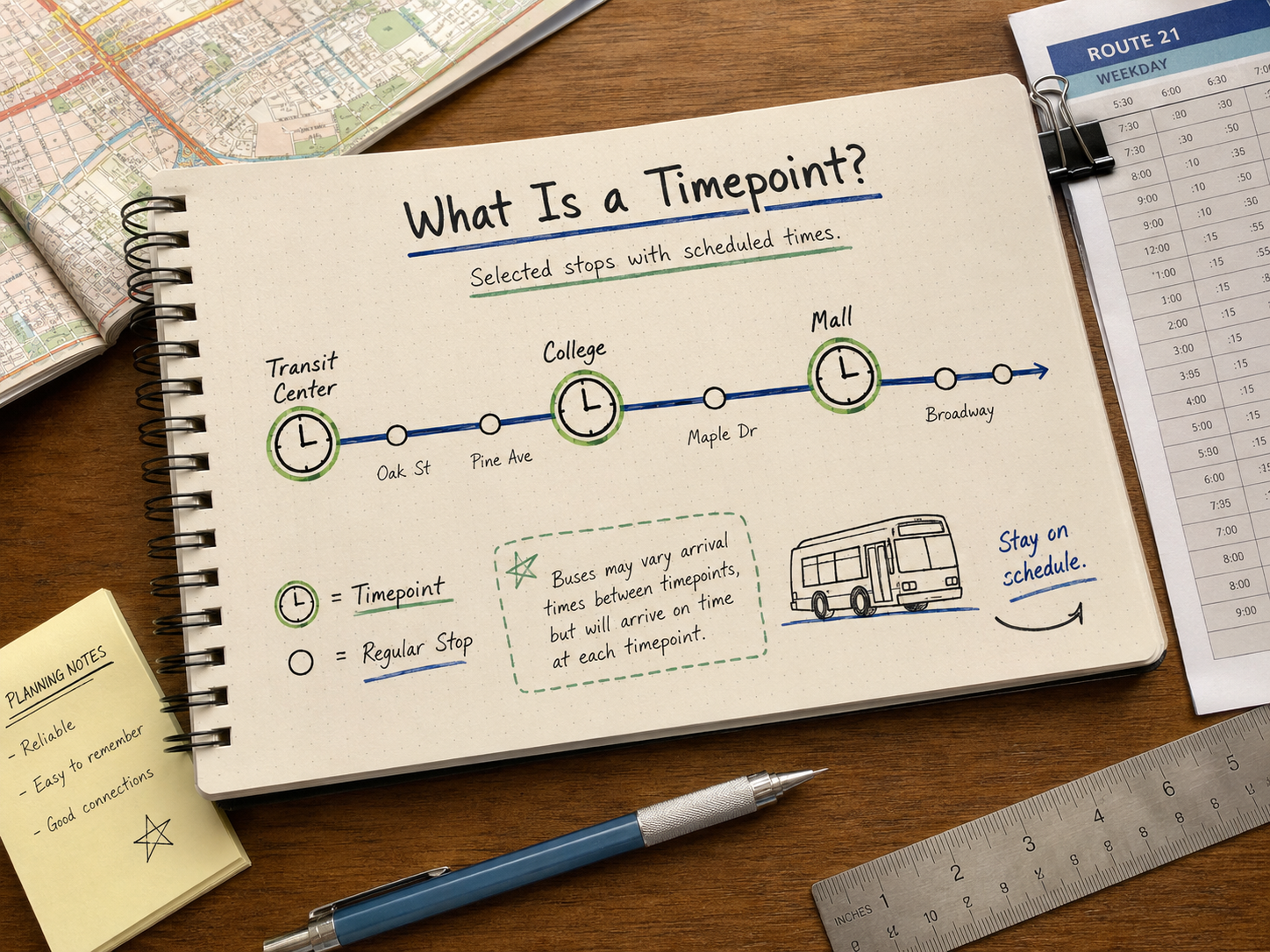
What Is a Timepoint - and Why Doesn't Every Bus Stop Have a Scheduled Time?
A bus may serve dozens of stops while the public timetable shows scheduled times at only a handful of locations. Those locations are timepoints, and they provide the structure that keeps a route understandable to passengers and manageable for operators.
Read Article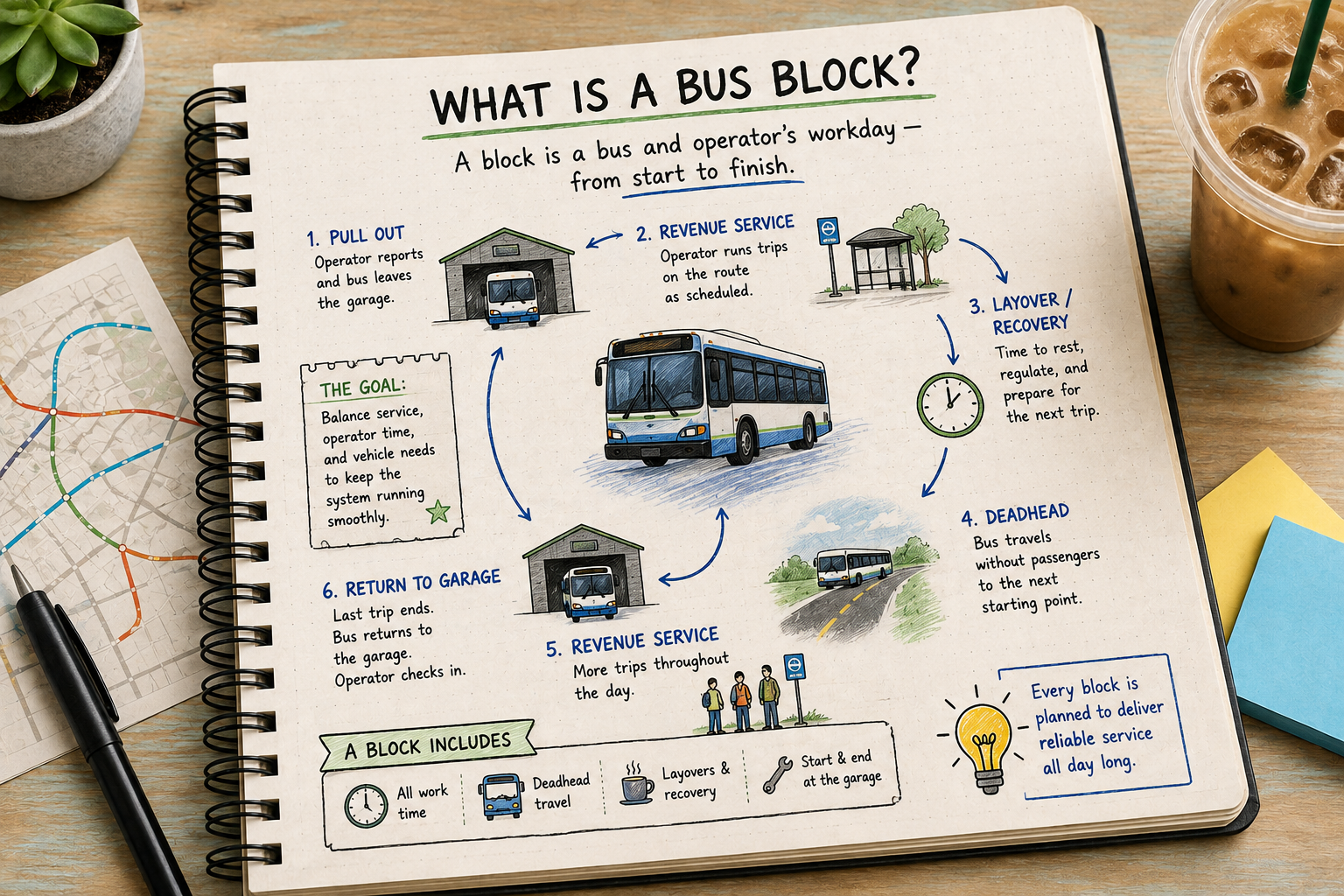
Scheduling Explained4 min read
What Is a Bus Block?
Passengers see routes and trips, but planners must also determine what each bus does throughout the day. A block connects individual trips, deadhead movements, layovers, and vehicle requirements into one continuous operating assignment.
Read Article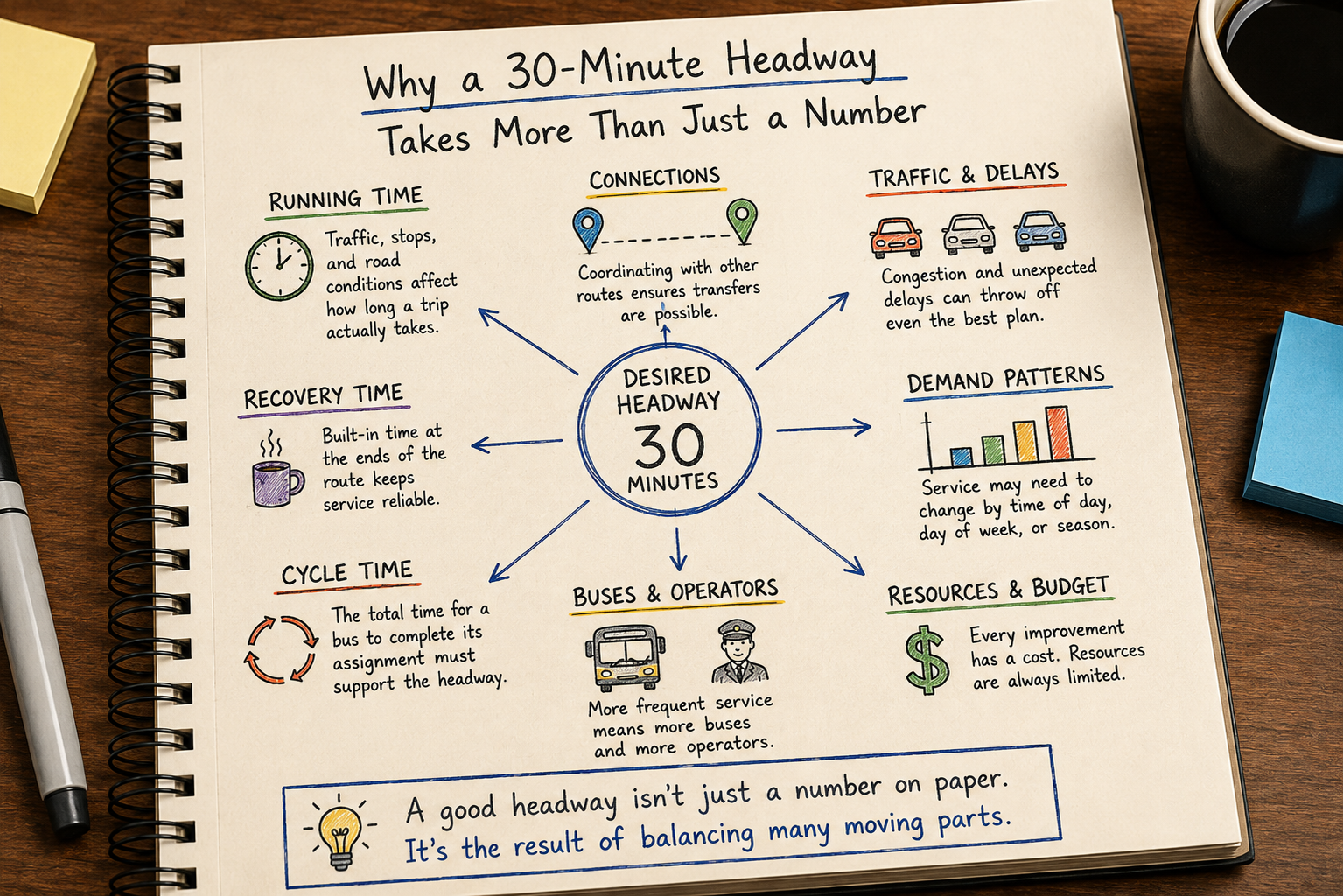
Scheduling Explained5 min read
Headways: Why “Every 30 Minutes” Is More Complicated Than It Sounds
A route that operates every 30 minutes may sound simple, but maintaining that frequency depends on running time, recovery, available buses, connections, and the overall cycle time of the route.
Read Article