Did the Service Change Actually Help?
How to compare the intended improvement with what riders and operators experience
By Craig3 min read
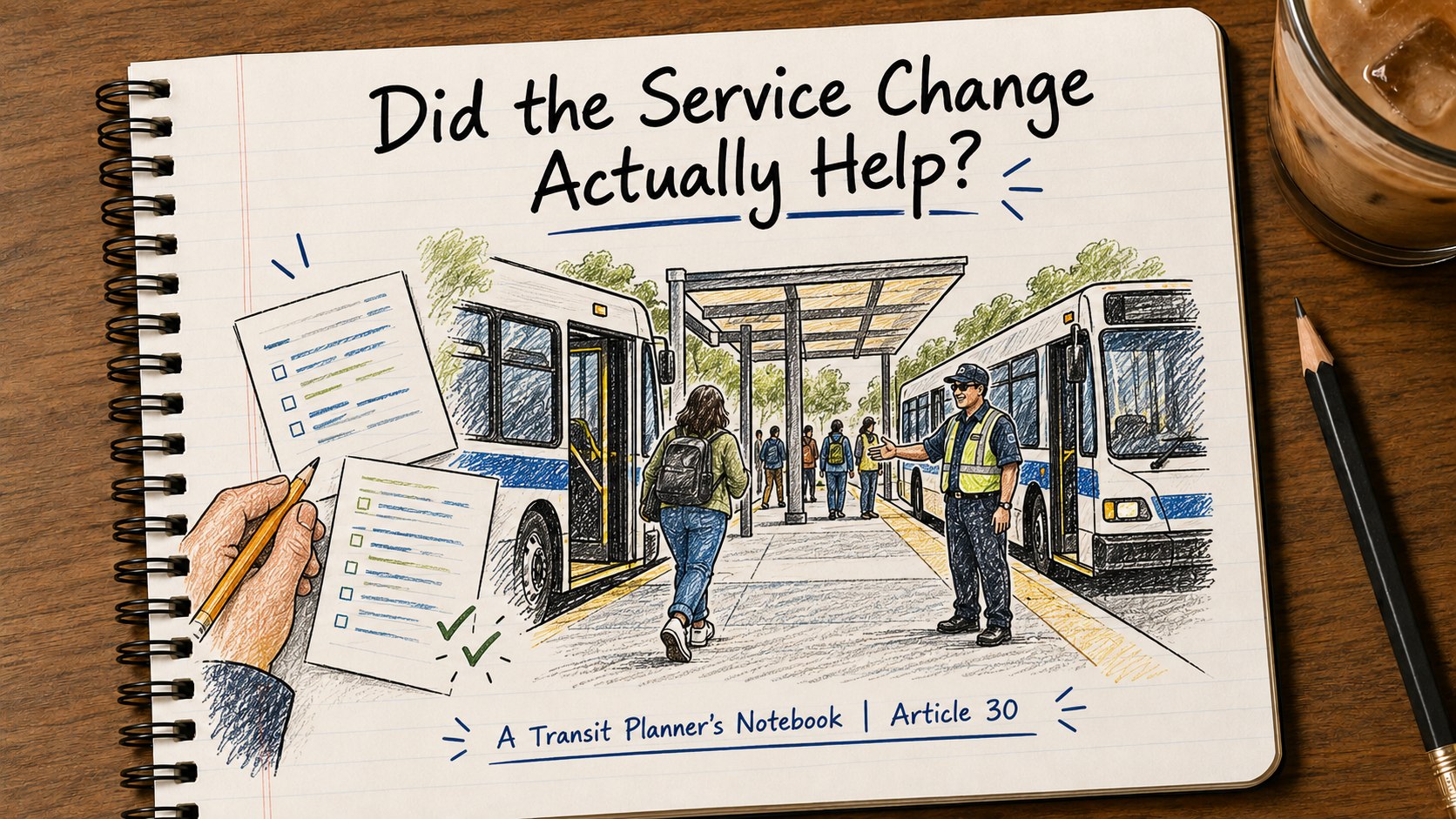
A timetable changes to improve a connection. The connecting bus now departs a few minutes later, and the revised schedule has been published.
The next question is whether passengers can actually make the transfer more reliably—and what the change has done elsewhere in the service.
How a Transit Service Change Goes from Idea to the Street followed a service change from the initial idea to the street. Evaluating the result is the next part of that work.
Start with the Problem the Change Was Meant to Solve
A review needs a clear objective.
For the transfer example, the intended result might be that passengers arriving on Route A can reach Route B under ordinary operating conditions.
That is specific enough to investigate. A broad statement such as “improve service” makes it harder to decide which evidence matters or whether the change achieved its purpose.
The original problem and the starting conditions should be recorded before implementation whenever possible. That gives the later review something meaningful to compare.
Compare Similar Trips
An ordinary school-day afternoon may behave differently from a holiday morning or a day with a major road closure.
Comparing those conditions without explanation can make a change appear more or less successful than it really is.
A useful review compares the same day types, periods, directions, and relevant trips before and after implementation. It also notes other changes that could influence the results, such as school calendars, traffic conditions, or another route's timetable.
The comparison does not have to begin with complicated analysis. It does need to be clear about what is being compared.
Choose Evidence That Matches the Goal
If the goal was a better transfer, review whether passengers reached the connecting bus and how long they waited.
Arrival and departure records can help, but they may not reveal whether riders had enough time to move between the boarding locations. Field observations and passenger feedback can fill that gap.
Other goals call for different evidence:
| Intended improvement | Practical evidence to review |
|---|---|
| A more usable connection | Successful transfers, actual walking time, and waiting time |
| An additional evening travel opportunity | Whether the full outbound and return journeys can be completed |
| Relief from crowding | Loads on the affected trips and any passengers unable to board |
| A more realistic timetable | Actual trip times, departure reliability, and time spent waiting at timepoints |
The measure should help answer the original question. An improvement in an unrelated statistic cannot establish that the passenger's problem was solved.
Read Early Results Carefully
Consider a hypothetical review of 20 comparable transfer opportunities before a change and 20 afterward.
Suppose passengers made the connection in 12 of the earlier observations and 17 of the later observations. That is an encouraging result worth investigating further.
The planner should still ask whether the observations reflect regular conditions. Were both groups drawn from similar days? Was construction affecting one period? Did the bus actually operate on all the trips being reviewed?
These are illustrative counts, not a proposed minimum sample or an agency performance standard. Continued monitoring helps determine whether the improvement holds as normal variation returns.
Look for Effects on Other Passengers
Moving Route B later may help transferring riders while lengthening the wait for passengers who already reached that stop on time.
The new departure may also affect a later connection, reduce terminal recovery, or move an operator relief. Those consequences need to be reviewed alongside the intended benefit.
Earlier articles introduced the pieces needed to ask these questions. Loads, service hours, day types, access, and operating arrangements all help describe what changed for people using and providing the service.
Listen and Check
Operators may notice a recurring delay that has moved to another location. Passengers may identify a return trip that still does not work.
Those observations deserve investigation. Compare them with repeated operating records and, when useful, visit the location during the affected period.
An urgent problem may require immediate attention. Longer-term results need another review after passengers have had a reasonable opportunity to understand and use the new service.
Explain the Finding and the Next Action
A useful evaluation states whether the intended improvement appeared, who experienced other effects, and what still needs attention.
The action might be to retain the change, adjust a departure, improve information, or reconsider the arrangement. Where other conditions changed too, explain their possible influence rather than assigning every result to the timetable revision.
Tags
This article reflects the author's personal experience and general industry knowledge. Agency practices, labor agreements, laws, funding requirements, and operating conditions vary.
Related Articles
Planner's Notebook2 min read
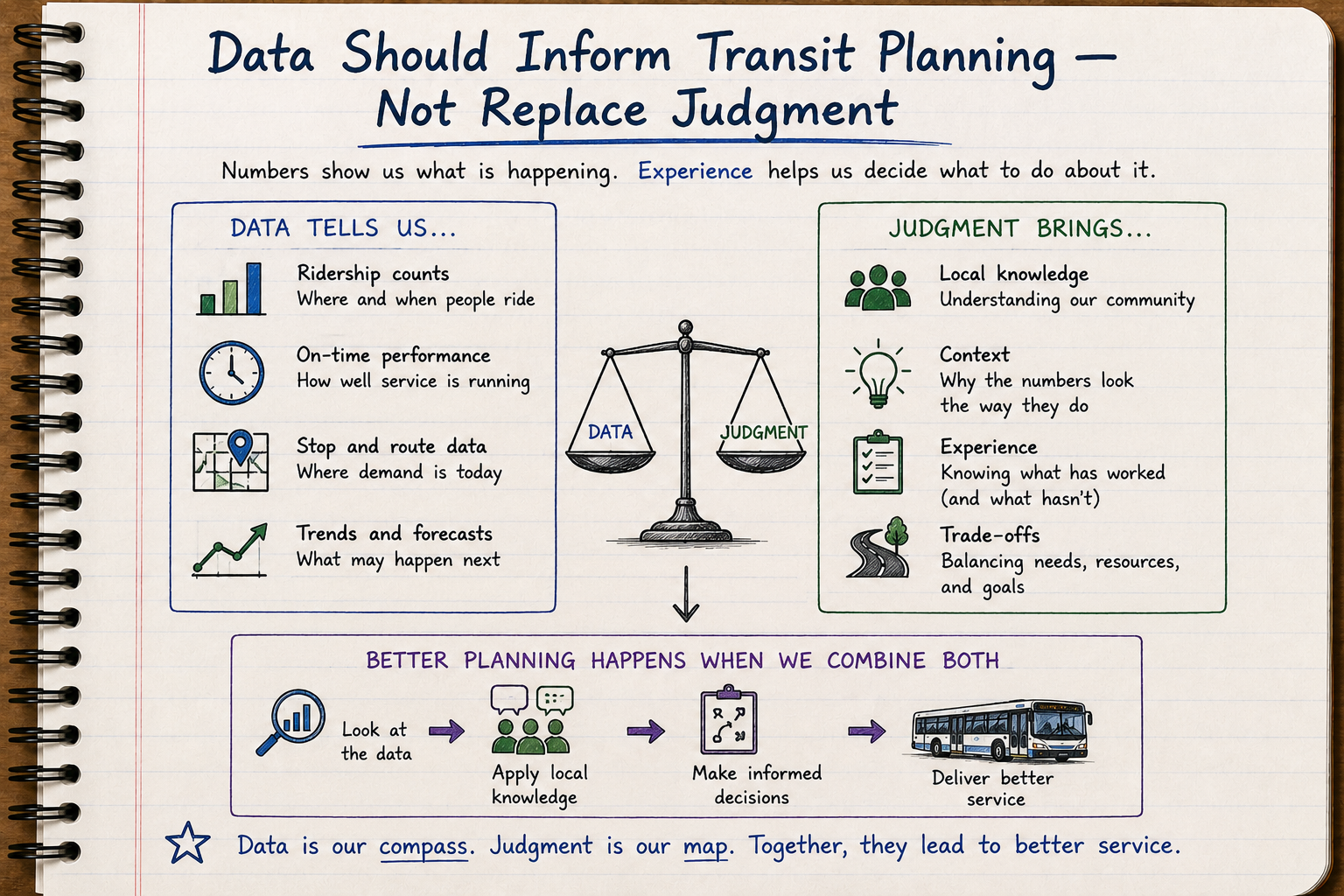
Data Should Inform Transit Planning - Not Replace Judgment
Modern transit planners have access to more data than ever before, but a spreadsheet cannot understand every reason behind a number. Good planning combines ridership, running time, and performance data with field knowledge, passenger needs, operator experience, and professional judgment.
Read Article