Data Should Inform Transit Planning - Not Replace Judgment
Why strong planning combines performance numbers with field observations, passenger needs, and operating experience
By Craig2 min read
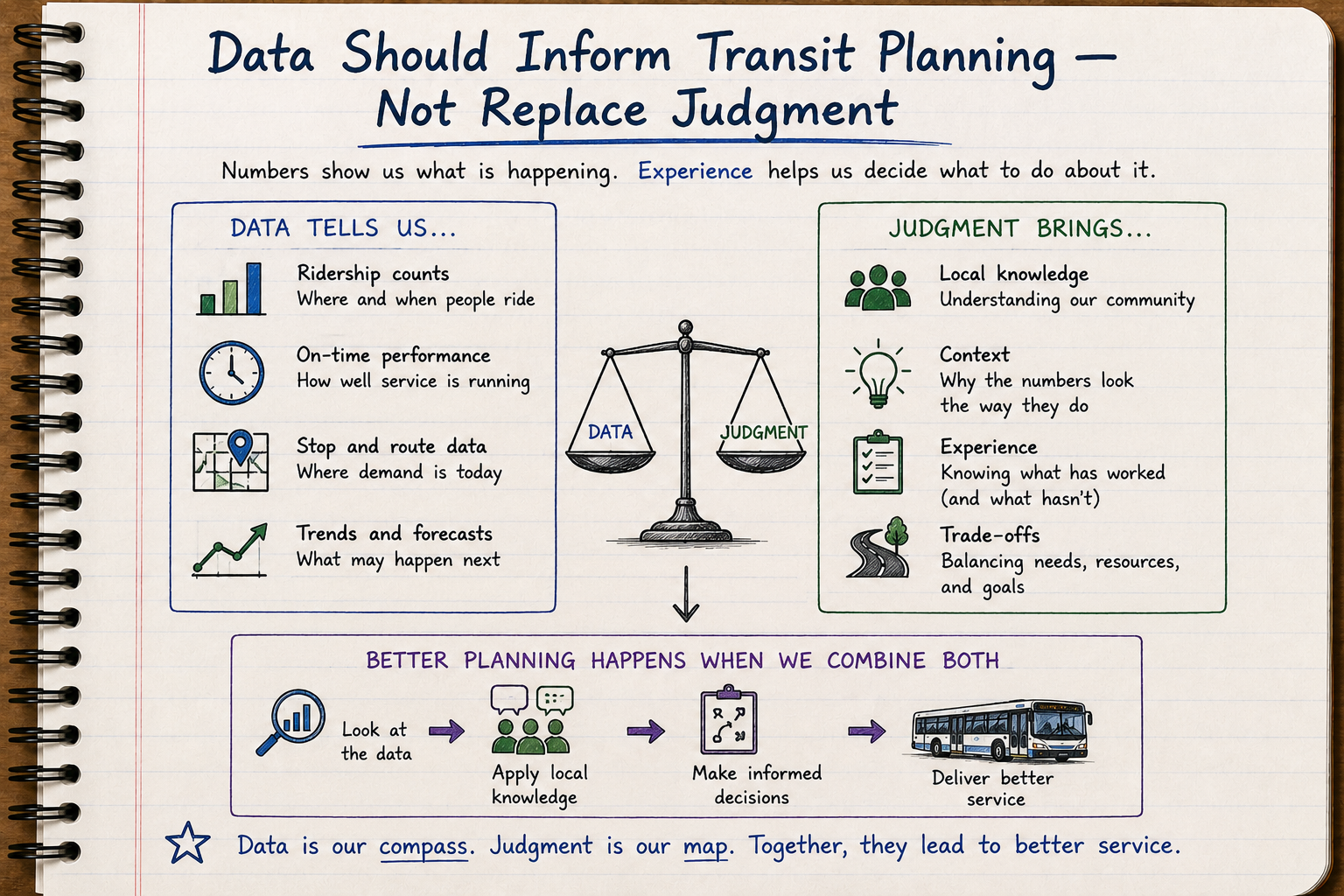
Transit planning has become increasingly data-driven.
That is a good thing.
Planners can now analyze millions of records involving:
- Running time
- On-time performance
- Passenger activity
- Vehicle location
- Schedule adherence
- Ridership
But data has one important limitation.
It tells us what happened much more easily than it tells us why.
A Number Is the Beginning of the Question
Suppose a trip has poor on-time performance.
The data tells us there is a problem.
It does not automatically tell us whether the cause is:
- Traffic
- Passenger load
- Road construction
- An unrealistic schedule
- A difficult turn
- A school dismissal
- A railroad crossing
- Bad data
That requires investigation.
Ridership Numbers Need Context
A low-ridership trip may look like an obvious candidate for elimination.
But who uses it?
Perhaps it is:
- The first trip available to early-shift workers
- The only connection to another route
- A rural trip with few alternatives
- The final evening trip home
Ridership is important, but public transportation serves purposes that are not always captured by ranking trips from highest to lowest passenger count.
Operator Knowledge Matters
Operators drive the route every day.
They may know that:
- One traffic signal routinely causes delays
- A stop has become heavily used
- A turn is difficult during school traffic
- A timetable location is unrealistic
That information should not automatically override data.
But it should not be ignored either.
The strongest analysis combines both.
Passenger Comments Are Data Too
Passenger comments are often anecdotal.
One complaint does not prove that an entire route needs to change.
Repeated comments about the same problem can identify something worth investigating.
Qualitative information can point planners toward questions the automated data did not reveal.
Data Can Be Wrong
Automated systems occasionally fail.
Examples include:
- Incorrect GPS positions
- Missing trips
- Bad route matching
- Incorrect stop configurations
- Vehicle communication failures
A report can contain thousands of rows and still be wrong.
Precision is not the same as accuracy.
Look for Patterns
One unusual trip should not automatically trigger a schedule change.
The planner should look for recurring patterns.
If the same segment loses five minutes almost every weekday afternoon, that is significant.
If it happened once because of a collision, that is different.
Good planning separates recurring conditions from unusual events.
The Real Goal Is Better Service
It is easy to become focused on metrics.
Increase OTP.
Reduce cost.
Increase passengers per hour.
Those measurements matter.
But they are tools.
The actual objective is to provide service that passengers can use and that the agency can reliably operate.
Tags
This article reflects the author's personal experience and general industry knowledge. Agency practices, labor agreements, laws, funding requirements, and operating conditions vary.